Advertisements
Advertisements
Question
This picture portrays a momentous event in 1765, involving a British Governor and a Mughal emperor wherein the Mughal emperor is conveying the grant of the Diwani to the governor.
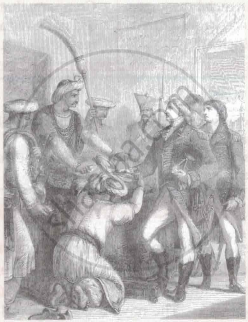
Give a brief account of the battle that preceded this event. When did it take place?
Advertisements
Solution
Mir Qasim was determined to take back his position as king. He fled to Awadh, where he established an alliance with Shuja-ud-Daulah, the nawab of Awadh, and the Mughal emperor Shah Alam II. In 1764, the united armies of the three allies met with the Company's men in Buxar, and the British destroyed them decisively. The British's success in the Battle of Buxar secured their position as masters of Bengal, Bihar, and Orissa.
APPEARS IN
RELATED QUESTIONS
Fill in the blanks:
__________, ___________ and __________ became the headquarters of the British settlements in the southern, western, and eastern regions, respectively.
Fill in the blanks:
In __________ Robert Clive recovered Calcutta which had been captured by Siraj-ud-Daulah in ___________.
Choose the correct answer:
Robert Clive hatched a plot with __________ to replace Siraj-ud-Daulah.
Answer the following question briefly:
The Battle of Plassey was a major turning point in the history of India. In this context answer the following question:
Give an account of the events leading from the conspiracy to replace Siraj-ud-Daulah to his eventual defeat in the Battle of Plassey.
Answer the following question briefly:
Mir Qasim was a competent ruler, determined to free himself from foreign control. In this context answer the following:
Trace the events from the outbreak of war (1763) between Mir Qasim and the British up to the Battle of Buxar in 1764.
What plot did Robert Clive hatch to remove Siraj-ud- Daulah?
Why did Siraj-ud-Daulah lose the Battle of Plassey?
Match the Contents of Column A Column B.
| Column A | Column B |
| 1. Shuja-ud-daulah | (a) Nawab of Bengal |
| 2. Shah Alam II | (b) Founder of British Empire in India |
| 3. Mir Qasim | (c) 1765 |
| 4. Siraj-ud-daulah | (d) 1765–1772 |
| 5. Battle of Plassey | (e) Calcutta |
| 6. Battle of Buxar | (f) Formed an alliance with the Mughal Emperor and Nawab of Awadh. |
| 7. Grant of Diwani | (g) Mughal Emperor |
| 8. Dual Government | (h) Nawab of Awadh |
| 9. Clive | (i) 1757 |
| 10. Forth William | (j) 1764 |
Answer the following question:
Describe the circumstances that led to the Battle of Buxar.
Answer the following question:
What were the causes and results of the First Anglo-Maratha War? When was it fought?
