Advertisements
Advertisements
Question
State whether the following is true or false:
The British army was defeated in the Battle of Buxar.
Options
True
False
Advertisements
Solution
False.
Correct Statement: The British army won in the Battle of Buxar.
APPEARS IN
RELATED QUESTIONS
Fill in the blank:
The British and the French fought the _________ Wars in India to establish their monopoly in trade.
Match the Column:
| Column A | Column B |
| 1. Carnatic Wars | (a) Warren Hastings |
| 2. Farman | (b) duty-free trade |
| 3. Roberts Clive | (c) reconquered Calcutta |
| 4. Battle of Plassey | (d) Siraj-ud-Daulah |
| 5. Battle of Buxar | (e) Anglo-French rivalry |
| 6. Governor of Bengal | (f) Mir Qasim |
Answer the following question in one or two words/sentences:
State the political significance of the Battle of Buxar.
Answer the following question briefly:
Mir Qasim was a competent ruler, determined to free himself from foreign control. In this context answer the following:
Explain the importance of the Battle of Buxar.
This picture portrays a momentous event in 1765, involving a British Governor and a Mughal emperor wherein the Mughal emperor is conveying the grant of the Diwani to the governor.
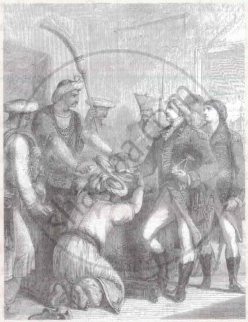
Give a brief account of the battle that preceded this event. When did it take place?
This picture portrays a momentous event in 1765, involving a British Governor and a Mughal emperor wherein the Mughal emperor is conveying the grant of the Diwani to the governor.

What is the importance of this battle?
What plot did Robert Clive hatch to remove Siraj-ud- Daulah?
The battle of Plassey is a turning point in the history of India. Explain.
Match the Contents of Column A Column B.
| Column A | Column B |
| 1. Shuja-ud-daulah | (a) Nawab of Bengal |
| 2. Shah Alam II | (b) Founder of British Empire in India |
| 3. Mir Qasim | (c) 1765 |
| 4. Siraj-ud-daulah | (d) 1765–1772 |
| 5. Battle of Plassey | (e) Calcutta |
| 6. Battle of Buxar | (f) Formed an alliance with the Mughal Emperor and Nawab of Awadh. |
| 7. Grant of Diwani | (g) Mughal Emperor |
| 8. Dual Government | (h) Nawab of Awadh |
| 9. Clive | (i) 1757 |
| 10. Forth William | (j) 1764 |
Answer the following question:
Describe the circumstances that led to the Battle of Buxar.
