Advertisements
Advertisements
Question
Choose the correct answer:
Alivardi Khan was succeeded by __________.
Options
Mir Qasim
Siraj-ud- Daulah
Shuja-ud-Daula
Advertisements
Solution
Alivardi Khan was succeeded by Siraj-ud-Daulah.
APPEARS IN
RELATED QUESTIONS
In 1717, the Mughal emperor granted the United East India Company the right to carry on duty-free trade in ______, ______, and ______.
Fill in the blank:
The British and the French fought the _________ Wars in India to establish their monopoly in trade.
Fill in the blanks:
In __________ Robert Clive recovered Calcutta which had been captured by Siraj-ud-Daulah in ___________.
State whether the following is true or false:
The British army was defeated in the Battle of Buxar.
Answer the following question briefly:
With reference to the Treaty of Allahabad and its impact, answer the following:
Explain how the treaty between Robert Clive and the Mughal emperor Shah Alam II legalized English East India’s Company’s control over Bengal.
This picture portrays a momentous event in 1765, involving a British Governor and a Mughal emperor wherein the Mughal emperor is conveying the grant of the Diwani to the governor.
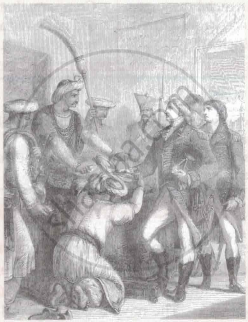
Give a brief account of the battle that preceded this event. When did it take place?
When and between whom was the Battle of Buxar fought?
Answer the following question:
What were the causes of Conflict between Siraj-ud-daulah and the English?
Answer the following question:
What were the results and significance of the Battle of Buxar?
Answer the following question:
What were the causes and results of the First Anglo-Maratha War? When was it fought?
