Advertisements
Advertisements
Question
Answer the following question briefly:
Mir Qasim was a competent ruler, determined to free himself from foreign control. In this context answer the following:
What steps did Mir Qasim take to strengthen his position? Why did he abolish all duties on internal trade?
Advertisements
Solution
To strengthen his position, Mir Qasim improved Bengal's financial position and raised a modern, disciplined, and well-equipped army trained by Europeans. The company's employees misused their trade privileges.
They sold their duty-free trade points to Indian merchants who also used them to carry on duty-free trade. This deprived the Nawab of large revenues. To put an end to the corrupt practices of the British, Mir Qasim abolished all duties on internal trade.
APPEARS IN
RELATED QUESTIONS
In 1717, the Mughal emperor granted the United East India Company the right to carry on duty-free trade in ______, ______, and ______.
Match the Column:
| Column A | Column B |
| 1. Carnatic Wars | (a) Warren Hastings |
| 2. Farman | (b) duty-free trade |
| 3. Roberts Clive | (c) reconquered Calcutta |
| 4. Battle of Plassey | (d) Siraj-ud-Daulah |
| 5. Battle of Buxar | (e) Anglo-French rivalry |
| 6. Governor of Bengal | (f) Mir Qasim |
State whether the following is true or false:
The British army was defeated in the Battle of Buxar.
Answer the following question briefly:
The Battle of Plassey was a major turning point in the history of India. In this context answer the following question:
Why is this battle considered a major turning point in the history of India?
Answer the following question briefly:
With reference to the Treaty of Allahabad and its impact, answer the following:
Give an account of the events that followed the death of Mir Jafar, leading to the establishment of the Company as the real ruler of Bengal.
This picture portrays a momentous event in 1765, involving a British Governor and a Mughal emperor wherein the Mughal emperor is conveying the grant of the Diwani to the governor.
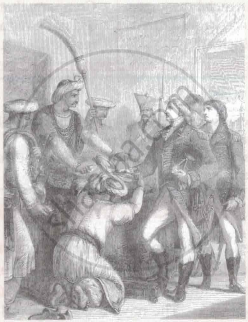
Give a brief account of the battle that preceded this event. When did it take place?
Match the Contents of Column A Column B.
| Column A | Column B |
| 1. Shuja-ud-daulah | (a) Nawab of Bengal |
| 2. Shah Alam II | (b) Founder of British Empire in India |
| 3. Mir Qasim | (c) 1765 |
| 4. Siraj-ud-daulah | (d) 1765–1772 |
| 5. Battle of Plassey | (e) Calcutta |
| 6. Battle of Buxar | (f) Formed an alliance with the Mughal Emperor and Nawab of Awadh. |
| 7. Grant of Diwani | (g) Mughal Emperor |
| 8. Dual Government | (h) Nawab of Awadh |
| 9. Clive | (i) 1757 |
| 10. Forth William | (j) 1764 |
Answer the following question:
Why did Mir Jafar enter into a conflict with the English East India Company?
Answer the following question:
How did Mir Qasim become the Nawab of Bengal?
Answer the following question:
What were the causes and results of the First Anglo-Maratha War? When was it fought?
