Advertisements
Advertisements
Question
Think and suggest some ways to minimise waste and pollutants at their source, taking your home as an example.
Advertisements
Solution
A lot of the waste that we generate at home is thrown into the sink or flushed down the toilet. This adds to the sewage. Sewage is generally treated before being disposed off in a water body. The same water body may be the source of water supply to the town. A few simple steps at home can minimize the strain imposed on the water supply system in cleaning the water for our use.
- Food, especially Indian food contains a lot of fats and oils. The leftover food items should not be thrown down the drain because they can choke the pipes when they harden. These when thrown in open drains block the soil pores, thereby decreasing their effectiveness to filter water. Therefore, such waste should be thrown in dustbins only.
- Solid wastes such as used tea leaves, food remain, plastic bags, soft toys, cotton and sanitary towels should not be thrown down the drains. Such wastes block the drains. They reduce the free flow of oxygen and thus, slow down the process of degradation.
- Various chemical products such as medicines, motor oils, paints, grease, machine oils and insecticides may kill water purifying microorganisms and hamper the degradation process. These should not be thrown down the drain.
APPEARS IN
RELATED QUESTIONS
What is the major source of fresh water in the city/town/village where you live?
Give reason of Alcohol is mixed with water and is used in car radiator.
What is the smallest particle of water ? Describe it’s structure.
How are clouds formed?
What is the effect of impurities present in the water on the melting point and boiling point of water?
How do fishes and aquatic animals survive when the pond gets covered with thick ice?
What is the importance of dissolved impurities in water?
Compare the effect of soaps and detergents on hard water.
Name a ‘pure form’ and an,‘impure form’ of water in the natural state.
Define ‘eutrophication’.
What is meant by the term ‘oil spill’?
State the causes of ‘eutrophication’.
What is meant by the term ‘offshore drilling’. State the main environmental effects of offshore drilling.
Select the correct word from the words in option to complete the sentence:
If pressure on the surface of water increases its boiling point ____ and freezing point ____.
State whether the following statement is True or False. If false, give the correct statement.
Snow and ice both are solid forms of water
A jumbled word is given here. Write the correct form of the word.
CHARREGE
A jumbled word is given here. Write the correct form of the word.
WOSN
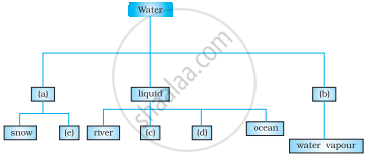
Complete the following chart by writing appropriate words in the boxes marked (a) to (e).
Why should we not throw used tea leaves into sink?
