Advertisements
Advertisements
Question
The vertices of a triangle are (6, 0), (0, 6) and (6, 6). The distance between its circumcentre and centroid is
Options
\[2\sqrt{2}\]
2
\[\sqrt{2}\]
1
Advertisements
Solution
\[\sqrt{2}\] Let A(0, 6), B(6, 0) and C(6, 6) be the vertices of the given triangle.
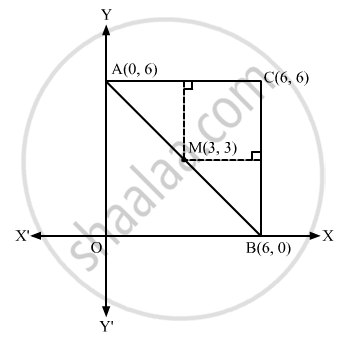
\[\text { Centroid of } \bigtriangleup \text { ABC } = \left( \frac{0 + 6 + 6}{3}, \frac{6 + 0 + 6}{3} \right)\]
\[ = \left( 4, 4 \right)\]
\[\text { Coordinates of N } = \left( \frac{6 + 6}{2}, \frac{6 + 0}{2} \right)\]
\[ = \left( 6, 3 \right)\]
\[\text { Coordinates of P } = \left( \frac{0 + 6}{2}, \frac{6 + 6}{2} \right)\]
\[ = \left( 3, 6 \right)\]
Equation of MN is y = 3
Equation of MP is x = 3
As , we know that circumcentre of a triangle is the intersection of the perpendicular
bisectors of any two sides .
Therefore, coordinates of circumcentre is (3, 3)
Thus, the coordinates of the circumcentre are (3, 3) and the centroid of the triangle is (4,4).
Let d be the distance between the circumcentre and the centroid.
\[\therefore d = \sqrt{\left( 4 - 3 \right)^2 + \left( 4 - 3 \right)^2} = \sqrt{2}\]
APPEARS IN
RELATED QUESTIONS
If the lines `(x-1)/2=(y+1)/3=(z-1)/4 ` and `(x-3)/1=(y-k)/2=z/1` intersect each other then find value of k
Find the distance between parallel lines:
15x + 8y – 34 = 0 and 15x + 8y + 31 = 0
Find the equation of the line parallel to y-axis and drawn through the point of intersection of the lines x– 7y + 5 = 0 and 3x + y = 0.
If sum of the perpendicular distances of a variable point P (x, y) from the lines x + y – 5 = 0 and 3x – 2y+ 7 = 0 is always 10. Show that P must move on a line.
A ray of light passing through the point (1, 2) reflects on the x-axis at point A and the reflected ray passes through the point (5, 3). Find the coordinates of A.
A line passes through a point A (1, 2) and makes an angle of 60° with the x-axis and intersects the line x + y = 6 at the point P. Find AP.
Find the distance of the point (3, 5) from the line 2x + 3y = 14 measured parallel to a line having slope 1/2.
Find the distance of the point (2, 5) from the line 3x + y + 4 = 0 measured parallel to a line having slope 3/4.
Find the perpendicular distance of the line joining the points (cos θ, sin θ) and (cos ϕ, sin ϕ) from the origin.
What are the points on X-axis whose perpendicular distance from the straight line \[\frac{x}{a} + \frac{y}{b} = 1\] is a ?
Show that the product of perpendiculars on the line \[\frac{x}{a} \cos \theta + \frac{y}{b} \sin \theta = 1\] from the points \[( \pm \sqrt{a^2 - b^2}, 0) \text { is }b^2 .\]
Find the perpendicular distance from the origin of the perpendicular from the point (1, 2) upon the straight line \[x - \sqrt{3}y + 4 = 0 .\]
What are the points on y-axis whose distance from the line \[\frac{x}{3} + \frac{y}{4} = 1\] is 4 units?
Show that the path of a moving point such that its distances from two lines 3x − 2y = 5 and 3x + 2y = 5 are equal is a straight line.
If sum of perpendicular distances of a variable point P (x, y) from the lines x + y − 5 = 0 and 3x − 2y + 7 = 0 is always 10. Show that P must move on a line.
Find the equation of two straight lines which are parallel to x + 7y + 2 = 0 and at unit distance from the point (1, −1).
Answer 3:
Find the equations of the lines through the point of intersection of the lines x − y + 1 = 0 and 2x − 3y+ 5 = 0, whose distance from the point(3, 2) is 7/5.
If the centroid of a triangle formed by the points (0, 0), (cos θ, sin θ) and (sin θ, − cos θ) lies on the line y = 2x, then write the value of tan θ.
Write the value of θ ϵ \[\left( 0, \frac{\pi}{2} \right)\] for which area of the triangle formed by points O (0, 0), A (a cos θ, b sin θ) and B (a cos θ, − b sin θ) is maximum.
L is a variable line such that the algebraic sum of the distances of the points (1, 1), (2, 0) and (0, 2) from the line is equal to zero. The line L will always pass through
The line segment joining the points (−3, −4) and (1, −2) is divided by y-axis in the ratio
The area of a triangle with vertices at (−4, −1), (1, 2) and (4, −3) is
Distance between the lines 5x + 3y − 7 = 0 and 15x + 9y + 14 = 0 is
The value of λ for which the lines 3x + 4y = 5, 5x + 4y = 4 and λx + 4y = 6 meet at a point is
A plane passes through (1, - 2, 1) and is perpendicular to two planes 2x - 2y + z = 0 and x - y + 2z = 4. The distance of the plane from the point (1, 2, 2) is ______.
The shortest distance between the lines
`bar"r" = (hat"i" + 2hat"j" + hat"k") + lambda (hat"i" - hat"j" + hat"k")` and
`bar"r" = (2hat"i" - hat"j" - hat"k") + mu(2hat"i" + hat"j" + 2hat"k")` is
If P(α, β) be a point on the line 3x + y = 0 such that the point P and the point Q(1, 1) lie on either side of the line 3x = 4y + 8, then _______.
Find the distance between the lines 3x + 4y = 9 and 6x + 8y = 15.
Show that the locus of the mid-point of the distance between the axes of the variable line x cosα + y sinα = p is `1/x^2 + 1/y^2 = 4/p^2` where p is a constant.
Find the points on the line x + y = 4 which lie at a unit distance from the line 4x + 3y = 10.
If the sum of the distances of a moving point in a plane from the axes is 1, then find the locus of the point.
The ratio in which the line 3x + 4y + 2 = 0 divides the distance between the lines 3x + 4y + 5 = 0 and 3x + 4y – 5 = 0 is ______.
Find the length of the perpendicular drawn from the point P(3, 2, 1) to the line `overliner = (7hati + 7hatj + 6hatk) + λ(-2hati + 2hatj + 3hatk)`
