Advertisements
Advertisements
Question
The time taken to assemble a car in a certain plant is a random variable having a normal distribution of 20 hours and a standard deviation of 2 hours. What is the probability that a car can be assembled at this plant in a period of time. Less than 19.5 hours?
Advertisements
Solution
Let x denotes the time taken to assemable cars mean µ = 20 hours and S.D σ = 2 hours
The standard normal variate
z = `(x - mu)/sigma`
= `(x - 20)/2`
P(less than 19.5 hours) = P(X < 19.5)
When x = 19.5
z = `19.5/2`
= `(-0.5)/2`
= 0.25
P(X < 19.5) = P(Z < – 0.25)
= P(`-oo` < z < 0) – P(– 0.25 < z < 0)
= 0.5 – P(0 < z < 0.25)
= 0.5 – 0.0987
= 0.4013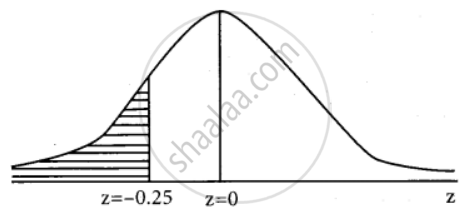
APPEARS IN
RELATED QUESTIONS
In a particular university 40% of the students are having newspaper reading habit. Nine university students are selected to find their views on reading habit. Find the probability that none of those selected have newspaper reading habit
A pair of dice is thrown 4 times. If getting a doublet is considered a success, find the probability of 2 successes
Mention the properties of poisson distribution
Assuming that a fatal accident in a factory during the year is 1/1200, calculate the probability that in a factory employing 300 workers there will be at least two fatal accidents in a year, (given e-0.25 = 0.7788).
If the heights of 500 students are normally distributed with mean 68.0 inches and standard deviation 3.0 inches, how many students have height between 65 and 71 inches
Choose the correct alternative:
Which of the following cannot generate a Poisson distribution?
Choose the correct alternative:
The random variable X is normally distributed with a mean of 70 and a standard deviation of 10. What is the probability that X is between 72 and 84?
Choose the correct alternative:
If P(Z > z) = 0.8508 what is the value of z (z has a standard normal distribution)?
Vehicles pass through a junction on a busy road at an average rate of 300 per hour. Find the probability that none passes in a given minute
X is a normally distributed variable with mean µ = 30 and standard deviation σ = 4. Find P(X < 40)
