Advertisements
Advertisements
Question
The time taken to assemble a car in a certain plant is a random variable having a normal distribution of 20 hours and a standard deviation of 2 hours. What is the probability that a car can be assembled at this plant in a period of time. Between 20 and 22 hours?
Advertisements
Solution
Let x denotes the time taken to assemable cars mean µ = 20 hours and S.D σ = 2 hours
The standard normal variate
z = `(x - mu)/sigma`
= `(x - 20)/2`
P(Between 20 and 22 hours) = P(20 < x < 22)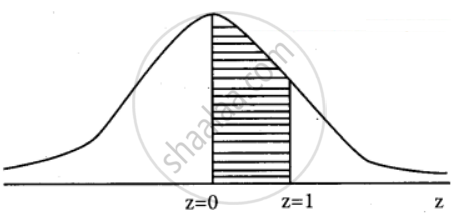
When x = 20
z = `(20 - 20)/2 = 0/2` = 0
When x = 22
z = `(22 - 20)/2 = 2/2` = 1
P(20 < x < 22) = P(0 < z < 1)
= 0.3413
APPEARS IN
RELATED QUESTIONS
Derive the mean and variance of binomial distribution
If 5% of the items produced turn out to be defective, then find out the probability that out of 20 items selected at random there are find the mean and variance
In a family of 3 children, what is the probability that there will be exactly 2 girls?
Out of 750 families with 4 children each, how many families would be expected to have atmost 2 girls
In a distribution 30% of the items are under 50 and 10% are over 86. Find the mean and standard deviation of the distribution
In a photographic process, the developing time of prints may be looked upon as a random variable having the normal distribution with a mean of 16.28 seconds and a standard deviation of 0.12 second. Find the probability that it will take less than 16.35 seconds to develop prints
Choose the correct alternative:
An experiment succeeds twice as often as it fails. The chance that in the next six trials, there shall be at least four successes is
Choose the correct alternative:
Monthly expenditure on their credit cards, by credit cardholders from a certain bank, follows a normal distribution with a mean of ₹ 1,295.00 and a standard deviation of ₹ 750.00. What proportion of credit cardholders spend more than ₹ 1,500.00 on their credit cards per month?
Vehicles pass through a junction on a busy road at an average rate of 300 per hour. What is the expected number passing in two minutes?
X is a normally distributed variable with mean µ = 30 and standard deviation σ = 4. Find P(X > 21)
