Advertisements
Advertisements
Question
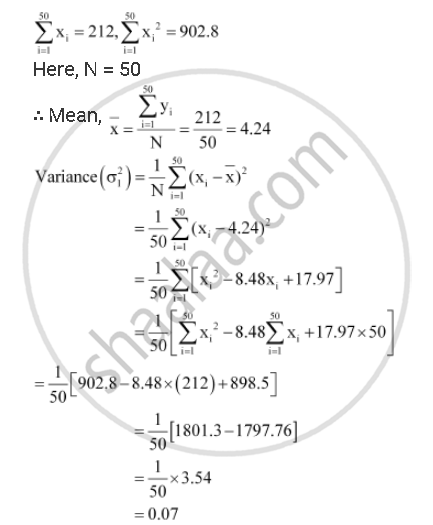
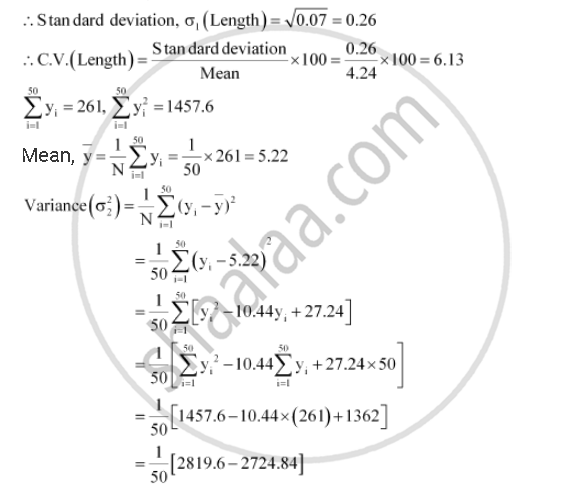
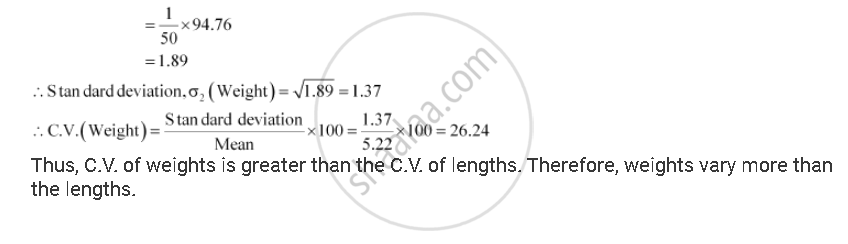
The sum and sum of squares corresponding to length x (in cm) and weight y (in gm) of 50 plant products are given below:
`sum_(i-1)^50 x_i = 212, sum_(i=1)^50 x_i^2 = 902.8, sum_(i=1)^50 y_i = 261, sum_(i = 1)^50 y_i^2 = 1457.6`
Which is more varying, the length or weight?
Advertisements
Solution
RELATED QUESTIONS
Find the mean and variance for the first n natural numbers.
The following is the record of goals scored by team A in a football session:
|
No. of goals scored |
0 |
1 |
2 |
3 |
4 |
|
No. of matches |
1 |
9 |
7 |
5 |
3 |
For the team B, mean number of goals scored per match was 2 with a standard deviation 1.25 goals. Find which team may be considered more consistent?
The mean and standard deviation of 20 observations are found to be 10 and 2, respectively. On rechecking, it was found that an observation 8 was incorrect. Calculate the correct mean and standard deviation in each of the following cases:
- If wrong item is omitted.
- If it is replaced by 12.
Find the mean, variance and standard deviation for the data:
2, 4, 5, 6, 8, 17.
Find the mean, variance and standard deviation for the data:
227, 235, 255, 269, 292, 299, 312, 321, 333, 348.
Find the mean, variance and standard deviation for the data 15, 22, 27, 11, 9, 21, 14, 9.
The variance of 20 observations is 5. If each observation is multiplied by 2, find the variance of the resulting observations.
The variance of 15 observations is 4. If each observation is increased by 9, find the variance of the resulting observations.
The mean and standard deviation of 100 observations were calculated as 40 and 5.1 respectively by a student who took by mistake 50 instead of 40 for one observation. What are the correct mean and standard deviation?
Show that the two formulae for the standard deviation of ungrouped data
\[\sigma = \sqrt{\frac{1}{n} \sum \left( x_i - X \right)^2_{}}\] and
\[\sigma' = \sqrt{\frac{1}{n} \sum x_i^2 - X^2_{}}\] are equivalent, where \[X = \frac{1}{n}\sum_{} x_i\]
Calculate the standard deviation for the following data:
| Class: | 0-30 | 30-60 | 60-90 | 90-120 | 120-150 | 150-180 | 180-210 |
| Frequency: | 9 | 17 | 43 | 82 | 81 | 44 | 24 |
Calculate the A.M. and S.D. for the following distribution:
| Class: | 0-10 | 10-20 | 20-30 | 30-40 | 40-50 | 50-60 | 60-70 | 70-80 |
| Frequency: | 18 | 16 | 15 | 12 | 10 | 5 | 2 | 1 |
A student obtained the mean and standard deviation of 100 observations as 40 and 5.1 respectively. It was later found that one observation was wrongly copied as 50, the correct figure being 40. Find the correct mean and S.D.
The weight of coffee in 70 jars is shown in the following table:
| Weight (in grams): | 200–201 | 201–202 | 202–203 | 203–204 | 204–205 | 205–206 |
| Frequency: | 13 | 27 | 18 | 10 | 1 | 1 |
Determine the variance and standard deviation of the above distribution.
Mean and standard deviation of 100 observations were found to be 40 and 10 respectively. If at the time of calculation two observations were wrongly taken as 30 and 70 in place of 3 and 27 respectively, find the correct standard deviation.
If the sum of the squares of deviations for 10 observations taken from their mean is 2.5, then write the value of standard deviation.
In a series of 20 observations, 10 observations are each equal to k and each of the remaining half is equal to − k. If the standard deviation of the observations is 2, then write the value of k.
If each observation of a raw data whose standard deviation is σ is multiplied by a, then write the S.D. of the new set of observations.
If v is the variance and σ is the standard deviation, then
If the S.D. of a set of observations is 8 and if each observation is divided by −2, the S.D. of the new set of observations will be
Let a, b, c, d, e be the observations with mean m and standard deviation s. The standard deviation of the observations a + k, b + k, c + k, d + k, e + k is
The standard deviation of first 10 natural numbers is
A set of n values x1, x2, ..., xn has standard deviation 6. The standard deviation of n values x1 + k, x2 + k, ..., xn + k will be ______.
The mean and standard deviation of a set of n1 observations are `barx_1` and s1, respectively while the mean and standard deviation of another set of n2 observations are `barx_2` and s2, respectively. Show that the standard deviation of the combined set of (n1 + n2) observations is given by
S.D. = `sqrt((n_1(s_1)^2 + n_2(s_2)^2)/(n_1 + n_2) + (n_1n_2 (barx_1 - barx_2)^2)/(n_1 + n_2)^2)`
If for distribution `sum(x - 5)` = 3, `sum(x - 5)^2` = 43 and total number of items is 18. Find the mean and standard deviation.
Let x1, x2, ..., xn be n observations and `barx` be their arithmetic mean. The formula for the standard deviation is given by ______.
The standard deviation of a data is ______ of any change in orgin, but is ______ on the change of scale.
The mean and standard deviation of six observations are 8 and 4, respectively. If each observation is multiplied by 3, find the new mean and new standard deviation of the resulting observations.
