Advertisements
Advertisements
प्रश्न
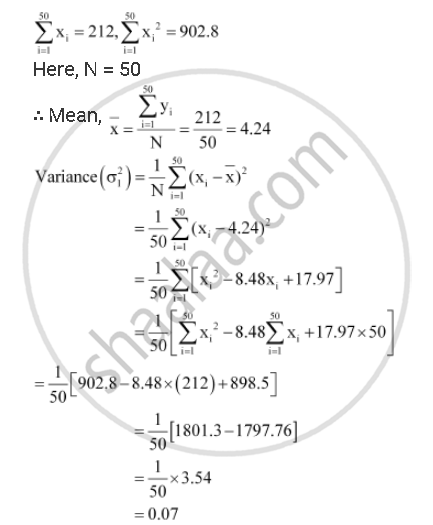
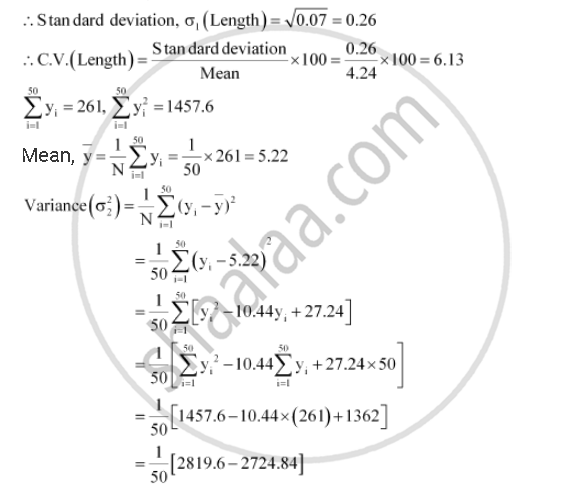
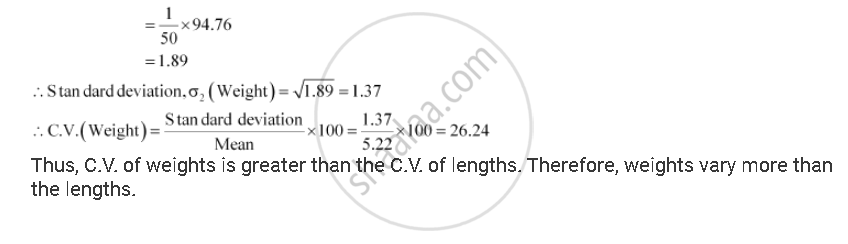
The sum and sum of squares corresponding to length x (in cm) and weight y (in gm) of 50 plant products are given below:
`sum_(i-1)^50 x_i = 212, sum_(i=1)^50 x_i^2 = 902.8, sum_(i=1)^50 y_i = 261, sum_(i = 1)^50 y_i^2 = 1457.6`
Which is more varying, the length or weight?
Advertisements
उत्तर
संबंधित प्रश्न
Find the mean and variance for the data.
6, 7, 10, 12, 13, 4, 8, 12
Find the mean and variance for the first 10 multiples of 3.
The mean and standard deviation of 20 observations are found to be 10 and 2, respectively. On rechecking, it was found that an observation 8 was incorrect. Calculate the correct mean and standard deviation in each of the following cases:
- If wrong item is omitted.
- If it is replaced by 12.
The mean and standard deviation of a group of 100 observations were found to be 20 and 3, respectively. Later on it was found that three observations were incorrect, which were recorded as 21, 21 and 18. Find the mean and standard deviation if the incorrect observations are omitted.
The variance of 20 observations is 5. If each observation is multiplied by 2, find the variance of the resulting observations.
The mean and standard deviation of 6 observations are 8 and 4 respectively. If each observation is multiplied by 3, find the new mean and new standard deviation of the resulting observations.
The mean and variance of 8 observations are 9 and 9.25 respectively. If six of the observations are 6, 7, 10, 12, 12 and 13, find the remaining two observations.
For a group of 200 candidates, the mean and standard deviations of scores were found to be 40 and 15 respectively. Later on it was discovered that the scores of 43 and 35 were misread as 34 and 53 respectively. Find the correct mean and standard deviation.
The mean and standard deviation of a group of 100 observations were found to be 20 and 3 respectively. Later on it was found that three observations were incorrect, which were recorded as 21, 21 and 18. Find the mean and standard deviation if the incorrect observations were omitted.
Find the standard deviation for the following data:
| x : | 3 | 8 | 13 | 18 | 23 |
| f : | 7 | 10 | 15 | 10 | 6 |
Calculate the standard deviation for the following data:
| Class: | 0-30 | 30-60 | 60-90 | 90-120 | 120-150 | 150-180 | 180-210 |
| Frequency: | 9 | 17 | 43 | 82 | 81 | 44 | 24 |
Calculate the A.M. and S.D. for the following distribution:
| Class: | 0-10 | 10-20 | 20-30 | 30-40 | 40-50 | 50-60 | 60-70 | 70-80 |
| Frequency: | 18 | 16 | 15 | 12 | 10 | 5 | 2 | 1 |
Find the mean and variance of frequency distribution given below:
| xi: | 1 ≤ x < 3 | 3 ≤ x < 5 | 5 ≤ x < 7 | 7 ≤ x < 10 |
| fi: | 6 | 4 | 5 | 1 |
The weight of coffee in 70 jars is shown in the following table:
| Weight (in grams): | 200–201 | 201–202 | 202–203 | 203–204 | 204–205 | 205–206 |
| Frequency: | 13 | 27 | 18 | 10 | 1 | 1 |
Determine the variance and standard deviation of the above distribution.
Mean and standard deviation of 100 observations were found to be 40 and 10 respectively. If at the time of calculation two observations were wrongly taken as 30 and 70 in place of 3 and 27 respectively, find the correct standard deviation.
Two plants A and B of a factory show following results about the number of workers and the wages paid to them
| Plant A | Plant B | |
| No. of workers | 5000 | 6000 |
| Average monthly wages | Rs 2500 | Rs 2500 |
| Variance of distribution of wages | 81 | 100 |
In which plant A or B is there greater variability in individual wages?
The mean and standard deviation of marks obtained by 50 students of a class in three subjects, mathematics, physics and chemistry are given below:
| Subject | Mathematics | Physics | Chemistry |
| Mean | 42 | 32 | 40.9 |
| Standard Deviation | 12 | 15 | 20 |
Which of the three subjects shows the highest variability in marks and which shows the lowest?
The standard deviation of the data:
| x: | 1 | a | a2 | .... | an |
| f: | nC0 | nC1 | nC2 | .... | nCn |
is
The standard deviation of first 10 natural numbers is
Let x1, x2, ..., xn be n observations. Let \[y_i = a x_i + b\] for i = 1, 2, 3, ..., n, where a and b are constants. If the mean of \[x_i 's\] is 48 and their standard deviation is 12, the mean of \[y_i 's\] is 55 and standard deviation of \[y_i 's\] is 15, the values of a and b are
Life of bulbs produced by two factories A and B are given below:
| Length of life (in hours) |
Factory A (Number of bulbs) |
Factory B (Number of bulbs) |
| 550 – 650 | 10 | 8 |
| 650 – 750 | 22 | 60 |
| 750 – 850 | 52 | 24 |
| 850 – 950 | 20 | 16 |
| 950 – 1050 | 16 | 12 |
| 120 | 120 |
The bulbs of which factory are more consistent from the point of view of length of life?
Find the standard deviation of the first n natural numbers.
The mean and standard deviation of some data for the time taken to complete a test are calculated with the following results:
Number of observations = 25, mean = 18.2 seconds, standard deviation = 3.25 seconds. Further, another set of 15 observations x1, x2, ..., x15, also in seconds, is now available and we have `sum_(i = 1)^15 x_i` = 279 and `sum_(i = 1)^15 x^2` = 5524. Calculate the standard derivation based on all 40 observations.
Two sets each of 20 observations, have the same standard derivation 5. The first set has a mean 17 and the second a mean 22. Determine the standard deviation of the set obtained by combining the given two sets.
The mean life of a sample of 60 bulbs was 650 hours and the standard deviation was 8 hours. A second sample of 80 bulbs has a mean life of 660 hours and standard deviation 7 hours. Find the overall standard deviation.
If for distribution `sum(x - 5)` = 3, `sum(x - 5)^2` = 43 and total number of items is 18. Find the mean and standard deviation.
The standard deviation of the data 6, 5, 9, 13, 12, 8, 10 is ______.
Let x1, x2, ..., xn be n observations and `barx` be their arithmetic mean. The formula for the standard deviation is given by ______.
Let a, b, c, d, e be the observations with mean m and standard deviation s. The standard deviation of the observations a + k, b + k, c + k, d + k, e + k is ______.
Coefficient of variation of two distributions are 50 and 60, and their arithmetic means are 30 and 25 respectively. Difference of their standard deviation is ______.
If the variance of a data is 121, then the standard deviation of the data is ______.
