The substance which is not reabsorbed into the blood capillaries surrounding the tuble of a nephron is mainly ______.
Advertisements
Question
The substance which is not reabsorbed into the blood capillaries surrounding the tuble of a nephron is mainly ______.
Options
glucose
amino acid
urea
water
Advertisements
Solution
The substance which is not reabsorbed into the blood capillaries surrounding the tuble of a nephron is mainly urea.
Explanation:
Urea is not reabsorbed into the blood capillaries surrounding the nephron tubule. However, glucose, amino acids, and water are reabsorbed.
APPEARS IN
RELATED QUESTIONS
Why is it necessary to excrete waste products?
Fill in the blank :
Nitrogenous wastes in the urine are in the form of urea and .....................
State if the following statement is true or false. Correct the statement if it is false.
Liver produces bile pigments from the hemoglobin of broken RBCs.
Answer the following in short.
List five waste products of plants.
If you donate one kidney to a needy patient, would it cause any harm to you? Give reason.
Fill in the blanks in the following passage to make it a meaningful description.
In a nephron, the ______ flows through the ______ under great pressure. The reason for this great pressure is that the ______ (outgoing) ______ is narrower than the ______ (incoming). This high pressure causes the ______ part of the blood to filter out from the ______ into the ______ capsule.
Define the following term:
Micturition
Given below is a simplified diagram of the human kidney cut open longitudinally. Answer the questions that follow.
 |
- Define excretion.
- Why does the cortex of the kidney show a dotted appearance?
- Why does the medulla of the kidney show a striped appearance?
- Write two differences in the composition of the blood flowing through the blood vessels 'A' and 'B'.
Explain the difference between the excretory system of humans and plants.
The following diagram represents a mammalian kidney tubule (nephron) and its blood supply.
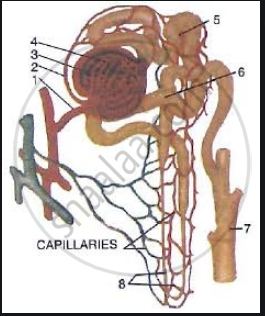
Parts indicated by the guidelines 1to 8 are as follows:
1. Afferent arteriole from renal artery
2. Efferent arteriole
3. Bowman's capsule
4. Glomerulus
5. Proximal convoluted tubule with blood capillaries
6. Distal convoluted tubule with blood capillaries
7. Collecting tubule
8. U-shaped loop of Henle
Study the diagram and answer the question that follow:
Which structure contains the highest concentration of urea?
Draw a labeled diagram of the human kidney as seen in a longitudinal section.
Explain the Term: Glomerulus
Give Technical Term:
The organ which filters out urea and uric acid from the bloodstream.
Complete the following sentence with appropriate word:
The U-shaped portion of a nephron located in the medulla region is called ______.
Complete the following sentence with appropriate word:
The knot of blood vessel inside the Bowman’s capsule is ______.
Osmoregulation maintains the osmolarity of blood at about ______.
In order to maintain homeostasis or constant internal environment . ______' is essential.
The process of diffusion of solvent particles from the region of less solute concentration to a region of high solute concentration through a semi-permeable membrane is known as ____________.
“All plants give out oxygen during the day and carbon dioxide during the night”. Do you agree with this statement? Give a reason.
