Advertisements
Advertisements
Question
The mechanical advantage of an ideal single movable pulley is ______.
Options
1
2
less than 2
less than 1
Advertisements
Solution
The mechanical advantage of an ideal single movable pulley is 2.
RELATED QUESTIONS
Explain how a gear system can be used to obtain gain in speed? Given one example.
Define the following term in reference to a gear system for Gain in speed ?
The diagram below shows an arrangement of three pulleys A, B, and C. The load is marked as L and the effort as E.
- Name the Pulleys A, B, and C.
- Mark in the diagram the directions of load (L), effort (E) and tension T1 and T2 in the two strings.
- How are the magnitudes of L and E related to the tension T1?
- Calculate the mechanical advantage and velocity ratio of the arrangement.
- What assumptions have you made in parts (c) and (d)?

A pulley system has a velocity ratio 3. Draw a diagram showing the point of application and direction of load (L), effort (E) and tension (T). It lifts a load of 150 N by an effort of 60 N. Calculate its mechanical advantage. Is the pulley system ideal? Give reason.
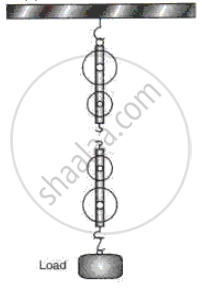
(a) Fig represents an incomplete diagram of a simple string pulley system. Copy this diagram on a new page and complete it and mark where the effort must be applied to lift the load.
(b) What is the velocity ratio of this system?
(c) If the pulley system is 80% efficient and the load is 720 N, then
(i) What effort must be applied to lift the load?
(ii) What work must be done must be done in lifting the load through a distance of 2 m using this machine?
There is no gain in mechanical advantage in the case of a single fixed pulley. Explain, why the pulley is then used?
A type of single pulley is very often used as a machine even though it does not give any gain in mechanical advantage. For what purpose is such a pulley used?
What is a block and tackle system of pulleys? What precautions would you observe while rounding the string so that the effort is applied in the downward direction?
A pulley is a machine made up of a ______.
