Advertisements
Advertisements
Question
The image formed by a convex mirror is
Options
Erect and diminished.
Erect and enlarged.
Inverted and diminished.
Inverted and enlarged.
Advertisements
Solution
The image formed by a convex mirror is Erect and diminished
APPEARS IN
RELATED QUESTIONS
Explain the following term related to spherical lenses:- principal axis
- A small object is placed 150 mm away from a diverging lens of focal length 100 mm.
- Copy the figure below and draw rays to show how an image is formed by the lens.
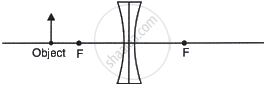
- Calculate the distance of the image from the lens by using the lens formula.
- Copy the figure below and draw rays to show how an image is formed by the lens.
- The diverging lens in part (a) is replaced by a converging lens also of focal length 100 mm. The object remains in the same position and an image is formed by the converging lens. Compare two properties of this image with those of the image formed by the diverging lens in part (a).
Mention the types of mirrors used as (i) rear view mirrors, (ii) shaving mirrors. List two reasons to justify your answers in each case.
If a spherical mirror breaks, what type of mirrors are the individual pieces?
What is a spherical mirror?
Define the terms pole, principal axis and centre of curvature with reference to a spherical mirror.
Define the term Centre of curvature.
A concave mirror can be used to produce a parallel beam of light. Draw a ray to illustrate this.
The image formed in a plane mirror is always inverted.
Visit a nearby hospital. You can also visit the clinic of an ENT specialist, or a dentist. Request the doctor to show you the mirrors used for examining ear, nose, throat and teeth. Can you recognise the kind of mirror used in these instruments?
