Advertisements
Advertisements
Question
The figure formed by joining the mid-points of the adjacent sides of a quadrilateral is a
Options
parallelogram
rectangle
square
rhombus
Advertisements
Solution
Figure can be drawn as:
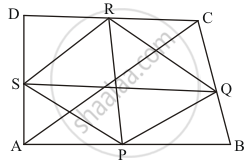
Let ABCD be a quadrilateral such that P,Q,R and S are the mid-points of side AB,BC,CD and DA respectively.
In ΔABC,P and Q are the mid-points of AB and BC respectively.
Therefore,
PQ || AC and `PQ = 1/2 AC`
Similarly, we have
RS || ACand `RS = 1/2 AC`
Thus,
PQ || RS and PQ = RS
Therefore, PQRSis a parallelogram.
The figure formed by joining the mid-points of the adjacent sides of a quadrilateral is a
parallelogram.
Hence the correct choice is (a).
APPEARS IN
RELATED QUESTIONS
Show that if the diagonals of a quadrilateral bisect each other at right angles, then it is a rhombus.
The following statement are true and false .
If all the angles of a quadrilateral are equal, it is a parallelogram .
The following statement are true and false .
If all the sides of a quadrilateral are equal it is a parallelogram.
The perimeter of a parallelogram is 22 cm. If the longer side measures 6.5 cm, what is the measure of shorter side?
If measures opposite angles of a parallelogram are (60 − x)° and (3x − 4)°, then find the measures of angles of the parallelogram.
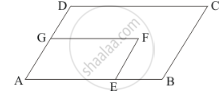
In the given figure, ABCD and AEFG are two parallelograms. If ∠C = 58°, find ∠F.
The figure formed by joining the mid-points of the adjacent sides of a rectangle is a
If one angle of a parallelogram is 24° less than twice the smallest angle, then the measure of the largest angle of the parallelogram is
ABCD is a parallelogram, M is the mid-point of BD and BM bisects ∠B. Then ∠AMB =
The diagonals of a parallelogram ABCD intersect at O. If ∠BOC = 90° and ∠BDC = 50°, then ∠OAB =
