Advertisements
Advertisements
Question
The bisectors of the angle of a parallelogram enclose a
Options
parallelogram
rhombus
rectangle
square
Advertisements
Solution
We have ABCD, a parallelogram given below:
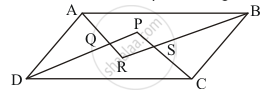
Therefore, we have AB || BC
Now, AD || BC and transversal AB intersects them at A and B respectively. Therefore,
Sum of consecutive interior angle is supplementary. That is;
∠A + ∠B = 180°
`1/2∠A + 1/2∠B = 90°`
We have AR and BR as bisectors of ∠A and ∠B respectively.
∠RAB +∠RBA = 90° …… (i)
Now, in ΔABR, by angle sum property of a triangle, we get:
∠RAB + ∠RBA +∠ARB = 180°
From equation (i), we get:
90° + ∠ARB = 180°
∠ARB = 90°
Similarly, we can prove that ∠DPC = 90° .
Now, AB || DC and transversal ADintersects them at A and D respectively. Therefore,
Sum of consecutive interior angle is supplementary. That is;
∠A + ∠D = 180°
`1/2∠A+1/2 ∠D = 90°`
We have AR and DP as bisectors of ∠A and ∠D respectively.
∠DAR + ∠ADP = 90° …… (ii)
Now, in ΔADR, by angle sum property of a triangle, we get:
∠DAR + ∠ADP + ∠AQD = 180°
From equation (i), we get:
90° +∠AQD = 180°
∠AQD = 90°
We know that ∠AQD and ∠PQR are vertically opposite angles, thus,
∠PQR = 90°
Similarly, we can prove that ∠PSR = 90° .
Therefore, PQRS is a rectangle.
Hence, the correct choice is (c).
APPEARS IN
RELATED QUESTIONS
ABCD is a rhombus. Show that diagonal AC bisects ∠A as well as ∠C and diagonal BD bisects ∠B as well as ∠D.
In a parallelogram ABCD, ∠D = 135°, determine the measures of ∠A and ∠B
The following statement are true and false .
In a parallelogram, the diagonals are equal
The following statement are true and false.
In a parallelogram, the diagonals bisect each other.
The following statement are true and false .
In any quadrilateral, if a pair of opposite sides is equal, it is a parallelogram.
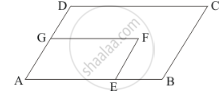
In the given figure, ABCD and AEFG are two parallelograms. If ∠C = 58°, find ∠F.
The figure formed by joining the mid-points of the adjacent sides of a rectangle is a
In a parallelogram ABCD, if ∠DAB = 75° and ∠DBC = 60°, then ∠BDC =
ABCD is a parallelogram, M is the mid-point of BD and BM bisects ∠B. Then ∠AMB =
Diagonals of a quadrilateral ABCD bisect each other. If ∠A= 45°, then ∠B =
