Advertisements
Advertisements
Question
The diagonals of the quadrilateral DEFG are ______ and ______.
Advertisements
Solution
The diagonals of the quadrilateral DEFG are DF and EG.
Explanation:
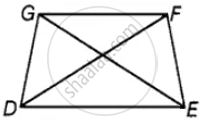
DF and EG are the opposite vertices of the quadrilateral and hence they create two diagonals.
APPEARS IN
RELATED QUESTIONS
In a quadrilateral, define of the following Opposite angles .
If ABCD is a rectangle with ∠BAC = 32°, find the measure of ∠DBC.
The angles A, B, C and D of a trapezium ABCD are in the ratio 3: 4: 5: 6. Le. ∠A : ∠B : ∠C : ∠D = 3:4: 5 : 6. Find all the angles of the trapezium. Also, name the two sides of this trapezium which are parallel to each other. Give reason for your answer.
The angles A, B, C and D of a quadrilateral are in the ratio 2 : 3 : 2 : 3. Show this quadrilateral is a parallelogram.
Find the angles of a pentagon which are in the ratio 4: 4: 6: 7: 6.
In a quadrilateral ABCD, ∠A = 72° and ∠C is the supplementary of ∠A. The other two angles are 2x – 10 and x + 4. Find the value of x and the measure of all the angles
In quadrilateral ROPE, the pairs of adjacent angles are ______.
What conclusion can be drawn from part of given figure, if BD bisects ∠ABC?

Draw a rough sketch of a quadrilateral KLMN. State two pairs of opposite angles.
Draw a rough sketch of a quadrilateral KLMN. State two pairs of adjacent sides.
