Advertisements
Advertisements
Question
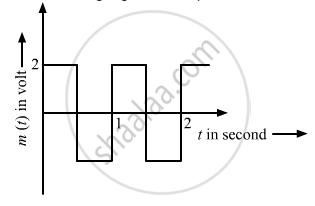
The carrier wave is represented by
Advertisements
Solution
Modulation index (\[\mu\]) is the ratio of the amplitude of the modulating signal to the amplitude of the carrier wave. The generalised equation of a carrier wave is given below: \[c(t) = A_c \sin \omega_c t\]
The generalised equation of a modulating wave is given below:
\[c_m (t) = A_c \sin \omega_c t + \mu A_c \sin \omega_m t\sin \omega_c t\]
Here,
Amplitude of modulating signal,
APPEARS IN
RELATED QUESTIONS
Define modulation and transducer
Define modulation index.
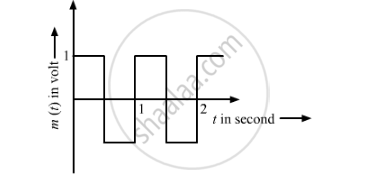
The carrier wave is given by
C(t) = 2sin(8πt) volt.
The modulating signal is a square wave as shown. Find modulation index.
Due to economic reasons, only the upper sideband of an AM wave is transmitted, but at the receiving station, there is a facility for generating the carrier. Show that if a device is available which can multiply two signals, then it is possible to recover the modulating signal at the receiver station.
Why is Modulation index kept low?
What is the role of a bandpass filter?
In a communication system, what is meant by modulation?
State any two types of modulation
Define the term modulation. Draw a block diagram of a simple modulator for obtaining AM signal ?
A speech signal of 3 kHz is used to modulate a carrier signal of frequency 1 MHz, using amplitude modulation. The frequencies of the sidebands will be ______.
