Advertisements
Advertisements
Question
State Kepler's laws of planetary motion.
Advertisements
Solution
Kepler’s first law (Law of orbit):
Every planet revolves around the sun in an elliptical orbit with the sun situated at one of the focii of the ellipse
Kepler’s second law (Law of equal areas):
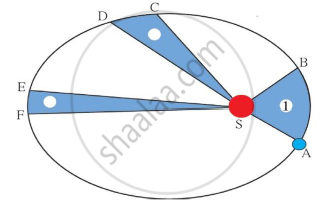
The radius vector drawn from the sun to any planet sweeps out equal areas in equal intervals of time, i.e., areal velocity of the radius vector is constant.
Kepler’s third law (Law of periods):
The square of the period of revolution of the planet round the sun is directly proportional to the cube of the semi-major axis of the elliptical orbit
APPEARS IN
RELATED QUESTIONS
State Kepler's law of orbit and law of equal areas.
Let us assume that our galaxy consists of 2.5 × 10¹¹ stars each of one solar mass. How long will a star at a distance of 50,000 ly from the galactic centre take to complete one revolution? Take the diameter of the Milky Way to be 105 ly
Identify the law shown in the figure and state three respective laws.
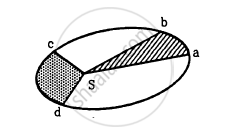
In the Following figure shows the elliptical path of a planet about the sun. The two shaded parts have equal area. If t1 and t2 be the time taken by the planet to go from a to b and from c to d respectively,
Answer the following question in detail.
State Kepler’s three laws of planetary motion.
Observe the given figure and answer these following questions.
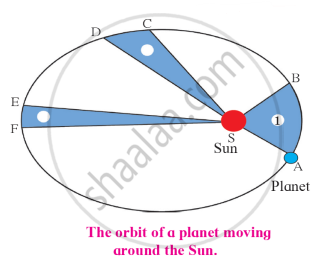
- What is the conclusion about the orbit of a planet?
- What is the relation between velocity of planet and distance from sun?
- ASB, CSD and ESF relation between areas explain.
Write the Kepler’s laws.
The third law of Kepler is also known as the Law of ______.
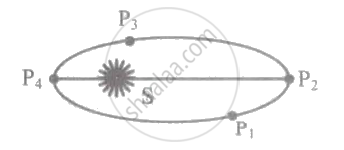
A planet is revolving around the sun in an elliptical orbit as shown in figure. At which point will its K.E. be maximum?
The mass and radius of earth is 'Me' and 'Re' respectively and that of moon is 'Mm' and 'Rm' respectively. The distance between the centre of the earth and that of moon is 'D'. The minimum speed required for a body (mass 'm') to project from a point midway between their centres to escape to infinity is ______.
A planet revolves in an elliptical orbit around the sun. The semi-major and minor axes are a and b, then the time period is given by:
Both earth and moon are subject to the gravitational force of the sun. As observed from the sun, the orbit of the moon ______.
If the sun and the planets carried huge amounts of opposite charges ______.
- all three of Kepler’s laws would still be valid.
- only the third law will be valid.
- the second law will not change.
- the first law will still be valid.
The centre of mass of an extended body on the surface of the earth and its centre of gravity ______.
- are always at the same point for any size of the body.
- are always at the same point only for spherical bodies.
- can never be at the same point.
- is close to each other for objects, say of sizes less than 100 m.
- both can change if the object is taken deep inside the earth.
Give one example each of central force and non-central force.
A star like the sun has several bodies moving around it at different distances. Consider that all of them are moving in circular orbits. Let r be the distance of the body from the centre of the star and let its linear velocity be v, angular velocity ω, kinetic energy K, gravitational potential energy U, total energy E and angular momentum l. As the radius r of the orbit increases, determine which of the above quantities increase and which ones decrease.
Earth’s orbit is an ellipse with eccentricity 0.0167. Thus, earth’s distance from the sun and speed as it moves around the sun varies from day to day. This means that the length of the solar day is not constant through the year. Assume that earth’s spin axis is normal to its orbital plane and find out the length of the shortest and the longest day. A day should be taken from noon to noon. Does this explain variation of length of the day during the year?
Two planets A and B of equal mass are having their period of revolutions TA and TB such that TA = 2TB. These planets are revolving in the circular orbits of radii rA and rB respectively. Which out of the following would be the correct relationship of their orbits?
What is one practical use of Kepler’s laws?
How can an ellipse be drawn using pins and thread?
What is at one focus of the elliptical orbit of a planet?
The time taken by a planet to orbit the Sun depends on ______.
When is a planet moving fastest in its orbit?
Two identical particles each of mass ‘m’ go round a circle of radius a under the action of their mutual gravitational attraction. The angular speed of each particle will be ______
