Obtain an expression for torque acting on a body rotating with uniform angular acceleration.
Advertisements
Questions
Obtain an expression for torque acting on a body rotating with uniform angular acceleration.
Obtain an expression for torque acting on a rigid body rotating with constant angular acceleration.
Advertisements
Solution
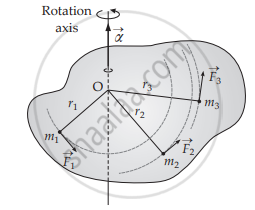
Consider a rigid body rotating about an axis passing through the point O and perpendicular to the plane of the figure. Suppose that a torque `vecτ` on the body produces uniform angular acceleration `vecα` along the axis of rotation.
The body can be considered as made up of N particles with masses m1, m2, ..., mN situated at perpendicular distances r1, r2, ..., rN respectively from the axis of rotation. `vecα` is the same for all the particles as the body is rigid. Let `vecF_1, vecF_2, ..., vecF_N` be the external forces on the particles.
The torque `vecτ_1`, on the particle of mass m1, is:
`vecτ_1 = vecr_1 × vecF_1`
∴ τ1 = r1F1 sin θ
where θ is the smaller of the two angles between `vecr_1` and `vecF_1`.
Since, in this case, θ = 90°
∴ τ1 = r1F1
Now, F1 = m1a1 = m1r1α
where a1 = r1α is the tangential acceleration of the particle.
∴ τ1 = r1(m1r1α)
= m1r12α
Similarly, τ2 = m2r22 α, ..., τN = mNrN2α
The total torque on the body is:
τ = τ1 + τ2 + ... + τN
= m1r12α + m2r22α + ... + mNrN2α
= (m1r12 + m2r22 + ... + mNrN2)α
= `(sum_(i = 1)^N m_ir_i^2)α`
∴ τ = I α
where I = `(sum_(i = 1)^N m_ir_i^2)` is the moment of inertia of the body about the axis of rotation.
RELATED QUESTIONS
Obtain an expression for the torque acting on a rotating body with constant angular acceleration. Hence state the dimensions and SI unit of torque.
Define moment of inertia. State its SI unit and dimensions.
A flywheel is revolving with a constant angular velocity. A chip of its rim breaks and flies away. What will be the effect on its angular velocity?
A charged particle (charge = q: mass = m) is rotating in a circle of radius 'R' with uniform speed 'v'. The ratio of its magnetic moment (M) to the angular momentum (L) is ______
Angular momentum of the earth revolving around the sun is proportional to rn , where r is the distance between the earth and the sun. Value of n is ____________.
If the angular momentum of a body increases by 50%, then its kinetic energy of rotation increases by ______ (M.I. remains constant)
A thin metal wire of length 'L' and uniform linear mass density 'ρ' is bent into a circular coil with 'O' as centre. The moment of inertia of a coil about the axis XX' is ______.
The angular momentum of electron in hydrogen atom is proportional to ____________.
If the kinetic energy of rotation of a body is doubled, then its angular momentum ____________.
Two bodies with moments of inertia I1 and I2 (I1 > I2) have equal angular momenta. lf E1 and E2 are their rotational kinetic energies respectively, then ____________.
A particle of mass m is rotating in a plane in a circular path of radius r. Its angular momentum is L. The centripetal force acting on the particle is ______.
If the angular momentum of an electron is `vec"J"` then the magnitude of the magnetic moment will be ____________.
A homogeneous disc of mass 2 kg and radius 15 cm is rotating about its axis (which is fixed) with an angular velocity of 4 radian/s. The linear momentum of the disc is ____________.
A particle is revolving in anticlockwise sense along the circumference of a circle of radius 'r' with linear velocity 'v', then the angle between 'v' and angular velocity 'ω' will be ______.
lf 'I' is the moment of inertia and 'L' is angular momentum of a rotating body, then `L^2/(2I)` is its ______.
Three-point masses each of mass 'M' are placed at the corners of an equilateral triangle of side 'a'. The moment of inertia of this system about an axis passing through one side of a triangle is ______.
An electron in an atom is revolving round the nucleus in a circular orbit of radius 5.3 × 10⁻¹¹ m with a speed of 3 × 10⁶ m/s. Find the angular momentum of electron.
A disc of moment of inertia 'I1' is rotating in horizontal plane about an axis passing through a centre and perpendicular to its plane with constant angular speed 'ω1'. Another disc of moment of inertia 'I2' having zero angular speed is placed co-axially on a rotating disc. Now, both the discs are rotating with constant angular speed 'ω2'. The energy lost by the initial rotating disc is ______.
A body is rotating about its own axis. Its rotational kinetic energy is x and its angular momentum is y, hence its moment of inertia about the axis is ______.
A particle of mass m = 5 unit is moving with a uniform speed v = 3`sqrt2` unit in the XY-plane along the line y = x + 4. The magnitude of the angular momentum about origin is ______.
The difference in the angular momentum of an electron in two successive orbits of a hydrogen atom is ______.
The angular momentum of the electron in the second orbit of hydrogen atom is L. The angular momentum in the third orbit is ______.
Define moment of inertia.
Define angular momentum.
Two whistles A and B have frequencies 660 Hz and 590 Hz respectively. An observer is standing in the middle of the line joining the two sources. he middle of the line joining the two sources. Source B and observer are moving towards right with velocity 30 m/s and A is stationary at left side. The number of beats listened by the observer are ______.
(Velocity of sound in air = 300 m/s)
