Advertisements
Advertisements
प्रश्न
Obtain an expression for torque acting on a body rotating with uniform angular acceleration.
Obtain an expression for torque acting on a rigid body rotating with constant angular acceleration.
Advertisements
उत्तर
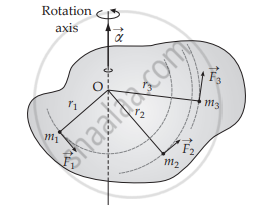
Consider a rigid body rotating about an axis passing through the point O and perpendicular to the plane of the figure. Suppose that a torque `vecτ` on the body produces uniform angular acceleration `vecα` along the axis of rotation.
The body can be considered as made up of N particles with masses m1, m2, ..., mN situated at perpendicular distances r1, r2, ..., rN respectively from the axis of rotation. `vecα` is the same for all the particles as the body is rigid. Let `vecF_1, vecF_2, ..., vecF_N` be the external forces on the particles.
The torque `vecτ_1`, on the particle of mass m1, is:
`vecτ_1 = vecr_1 × vecF_1`
∴ τ1 = r1F1 sin θ
where θ is the smaller of the two angles between `vecr_1` and `vecF_1`.
Since, in this case, θ = 90°
∴ τ1 = r1F1
Now, F1 = m1a1 = m1r1α
where a1 = r1α is the tangential acceleration of the particle.
∴ τ1 = r1(m1r1α)
= m1r12α
Similarly, τ2 = m2r22 α, ..., τN = mNrN2α
The total torque on the body is:
τ = τ1 + τ2 + ... + τN
= m1r12α + m2r22α + ... + mNrN2α
= (m1r12 + m2r22 + ... + mNrN2)α
= `(sum_(i = 1)^N m_ir_i^2)α`
∴ τ = I α
where I = `(sum_(i = 1)^N m_ir_i^2)` is the moment of inertia of the body about the axis of rotation.
संबंधित प्रश्न
Obtain an expression for the torque acting on a rotating body with constant angular acceleration. Hence state the dimensions and SI unit of torque.
Define moment of inertia. State its SI unit and dimensions.
A 500 kg car takes a round turn of the radius of 50m with a velocity of 36 km/hr. The centripetal force is ______.
A flywheel is revolving with a constant angular velocity. A chip of its rim breaks and flies away. What will be the effect on its angular velocity?
An electron(e) is revolving in a circular orbit of radius r in the hydrogen atom. The angular momentum of the electron is (M = magnetic dipole moment associated with it and m = mass of electron)
A stone of mass 1 kg is rotated in a horizontal circle of radius 0.5 m. If it makes `100/pi` rps, then its angular momentum is ______
Angular momentum of the earth revolving around the sun is proportional to rn , where r is the distance between the earth and the sun. Value of n is ____________.
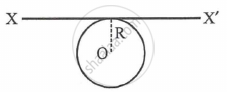
A thin metal wire of length 'L' and uniform linear mass density 'ρ' is bent into a circular coil with 'O' as centre. The moment of inertia of a coil about the axis XX' is ______.
Two bodies with moments of inertia I1 and I2 (I1 > I2) have equal angular momenta. lf E1 and E2 are their rotational kinetic energies respectively, then ____________.
A particle of mass m is rotating in a plane in a circular path of radius r. Its angular momentum is L. The centripetal force acting on the particle is ______.
If the angular momentum of an electron is `vec"J"` then the magnitude of the magnetic moment will be ____________.
A homogeneous disc of mass 2 kg and radius 15 cm is rotating about its axis (which is fixed) with an angular velocity of 4 radian/s. The linear momentum of the disc is ____________.
Let I1 and I2 be the moments of inertia of two bodies of identical geometrical shape. If the first body is made of aluminium and the second of iron, then ____________.
The direction of angular momentum of particle is ____________.
If E, M and P are the kinetic energy, mass and linear momentum of a particle respectively, which of the following relations represents the angular momentum L of the particle when the particle rotates in a circle of radius R?
lf 'I' is the moment of inertia and 'L' is angular momentum of a rotating body, then `L^2/(2I)` is its ______.
A disc of moment of inertia 'I1' is rotating in horizontal plane about an axis passing through a centre and perpendicular to its plane with constant angular speed 'ω1'. Another disc of moment of inertia 'I2' having zero angular speed is placed co-axially on a rotating disc. Now, both the discs are rotating with constant angular speed 'ω2'. The energy lost by the initial rotating disc is ______.
A body is rotating about its own axis. Its rotational kinetic energy is x and its angular momentum is y, hence its moment of inertia about the axis is ______.
The difference in the angular momentum of an electron in two successive orbits of a hydrogen atom is ______.
The angular momentum of the electron in the second orbit of hydrogen atom is L. The angular momentum in the third orbit is ______.
Define moment of inertia.
Calculate the change in angular momentum of the electron when it jumps from third orbit to first orbit in hydrogen atom.
(Take h = 6.33 × 10⁻³⁴ Js)
Two whistles A and B have frequencies 660 Hz and 590 Hz respectively. An observer is standing in the middle of the line joining the two sources. he middle of the line joining the two sources. Source B and observer are moving towards right with velocity 30 m/s and A is stationary at left side. The number of beats listened by the observer are ______.
(Velocity of sound in air = 300 m/s)
