Advertisements
Advertisements
Question
What is the direction of areal velocity of the earth around the sun?
Advertisements
Solution
Areal velocity of the earth around the sun is given by `(dA)/(dt) = L/(2m)` where L is the angular momentum and m is the mass of the earth.
But angular momentum `L = r xx p = r xx mv`
∴ Areal velocity `((dA)/(dt)) = 1/(2m) (r xx mv) = 1/2 (r xx v)`
Therefore, the direction of areal velocity `((dA)/(dt))` is the direction of `(r xx v)`, i.e., perpendicular to the plane containing r and v and directed as given by the right-hand rule.
APPEARS IN
RELATED QUESTIONS
Let us assume that our galaxy consists of 2.5 × 10¹¹ stars each of one solar mass. How long will a star at a distance of 50,000 ly from the galactic centre take to complete one revolution? Take the diameter of the Milky Way to be 105 ly
Let the period of revolution of a planet at a distance R from a star be T. Prove that if it was at a distance of 2R from the star, its period of revolution will be \[\sqrt{8}\] T.
Answer the following question.
State Kepler’s law of equal areas.
Answer the following question in detail.
State Kepler’s three laws of planetary motion.
The orbit of a planet revolving around a star is ______.
The square of its period of revolution around the sun is directly proportional to the ______ of the mean distance of a planet from the sun.
The third law of Kepler is also known as the Law of ______.
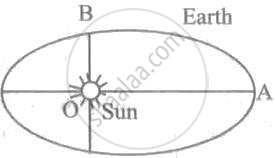
The earth moves around the sun in an elliptical orbit as shown in the figure. The ratio, `"OA"/"OB"` = x. The ratio of the speed of the earth at Band at A is ______.
To verify Kepler's third law graphically four students plotted graphs. Student A plotted a graph of T (period of revolution of planets) versus r (average distance of planets from the sun) and found the plot is straight line with slope 1.85. Student B plotted a graph of T2 v/s r3 and found the plot is straight line with slope 1.39 and negative Y-intercept. Student C plotted graph of log T v/s log r and found the plot is straight line with slope 1.5. Student D plotted graph of log T v/s log r and found the plot is straight line with slope 0.67 and with negative X-intercept. The correct graph is of student
A planet revolves in an elliptical orbit around the sun. The semi-major and minor axes are a and b, then the time period is given by:
Both earth and moon are subject to the gravitational force of the sun. As observed from the sun, the orbit of the moon ______.
In our solar system, the inter-planetary region has chunks of matter (much smaller in size compared to planets) called asteroids. They ______.
Supposing Newton’s law of gravitation for gravitation forces F1 and F2 between two masses m1 and m2 at positions r1 and r2 read F1 = – F2 = `- r_12/r_12^3 GM_0^2 ((m_1m_2)/M_0^2)^n` where M0 is a constant of dimension of mass r12 = r1 – r2 and n is a number. in such a case.
- the acceleration due to gravity on earth will be different for different objects.
- none of the three laws of Kepler will be valid.
- only the third law will become invalid.
- for n negative, an object lighter than water will sink in water.
The centre of mass of an extended body on the surface of the earth and its centre of gravity ______.
- are always at the same point for any size of the body.
- are always at the same point only for spherical bodies.
- can never be at the same point.
- is close to each other for objects, say of sizes less than 100 m.
- both can change if the object is taken deep inside the earth.
Give one example each of central force and non-central force.
Draw areal velocity versus time graph for mars.
A star like the sun has several bodies moving around it at different distances. Consider that all of them are moving in circular orbits. Let r be the distance of the body from the centre of the star and let its linear velocity be v, angular velocity ω, kinetic energy K, gravitational potential energy U, total energy E and angular momentum l. As the radius r of the orbit increases, determine which of the above quantities increase and which ones decrease.
