Advertisements
Advertisements
Question
Solve the following pair of linear equation by the elimination method and the substitution method.
`x/2 + (2y)/3 = -1 and x - y /3 = 3`
Advertisements
Solution
`x/2 + (2y)/3 = - 1` and `x - y/3 = 3`
By elimination method
`x/2 + (2y)/3 = -`1 ...(i)
`x-y/3 = 3` ...(ii)
Multiplying equation (i) by 2, we get
`x + (4y)/3 = - 2` ...(iii)
Subtracting equation (ii) from equation (iii), we get
`(5y)/3 = -5`
Dividing by 5 and multiplying by 3, we get
`y = -15/5`
y = -3
Putting this value in equation (ii), we get
`x - y/3 = 3` ...(ii)
`x-(-3)/3 = 3`
x + 1 = 3
x = 2
Hence, our answer is x = 2 and y = −3.
By substitution method
`x - y/3 = 3` ...(ii)
Add `y/3` both side, we get
`x = 3 + y/3` ...(iv)
Putting this value in equation (i), we get
`x/2 + (2y)/3 = - 1` ...(i)
`(3+ y/3)/2 + (2y)/3 = -1 `
`3/2 + y/6 + (2y)/3 = - 1`
Multiplying by 6, we get
9 + y + 4y = - 6
5y = -15
y = - 3
Hence, our answer is x = 2 and y = −3.
APPEARS IN
RELATED QUESTIONS
Solve the following system of linear equations by using the method of elimination by equating the coefficients √3x – √2y = √3 = ; √5x – √3y = √2
Solve the following pair of linear equation by the elimination method and the substitution method:
x + y = 5 and 2x – 3y = 4
Form the pair of linear equation in the following problem, and find its solution (if they exist) by the elimination method:
A lending library has a fixed charge for the first three days and an additional charge for each day thereafter. Saritha paid Rs 27 for a book kept for seven days, while Susy paid Rs 21 for the book she kept for five days. Find the fixed charge and the charge for each extra day.
Two types of boxes A, B are to be placed in a truck having a capacity of 10 tons. When 150 boxes of type A and 100 boxes of type B are loaded in the truck, it weighes 10 tons. But when 260 boxes of type A are loaded in the truck, it can still accommodate 40 boxes of type B, so that it is fully loaded. Find the weight of each type of box.
Out of 1900 km, Vishal travelled some distance by bus and some by aeroplane. The bus travels with an average speed of 60 km/hr and the average speed of the aeroplane is 700 km/hr. It takes 5 hours to complete the journey. Find the distance, Vishal travelled by bus.
If the length of a rectangle is reduced by 5 units and its breadth is increased by 3 units, then the area of the rectangle is reduced by 9 square units. If length is reduced by 3 units and breadth is increased by 2 units, then the area of rectangle will increase by 67 square units. Then find the length and breadth of the rectangle.
Solve the following simultaneous equation.
x - 2y = -1 ; 2x - y = 7
Solve the following simultaneous equation.
2x - y = 5 ; 3x + 2y = 11
Solve the following simultaneous equation.
x − 2y = −2 ; x + 2y = 10
A fraction becomes `(1)/(3)` when 2 is subtracted from the numerator and it becomes `(1)/(2)` when 1 is subtracted from the denominator. Find the fraction.
If 52x + 65y = 183 and 65x + 52y = 168, then find x + y = ?
Complete the activity.
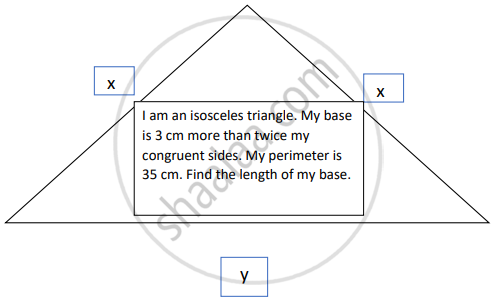
Solve: 99x + 101y = 499; 101x + 99y = 501
The angles of a cyclic quadrilateral ABCD are ∠A = (6x + 10)°, ∠B = (5x)°, ∠C = (x + y)°, ∠D = (3y – 10)°. Find x and y, and hence the values of the four angles.
The ratio of two numbers is 2:3. If 5 is added in each numbers, then the ratio becomes 5:7 find the numbers.
The ratio of two numbers is 2:3.
So, let the first number be 2x and the second number be `square`.
From the given condition,
`((2x) + square)/(square + square) = square/square`
`square (2x + square) = square (square + square)`
`square + square = square + square`
`square - square = square - square`
`- square = - square`
x = `square`
So, The first number = `2 xx square = square`
and, Second number = `3 xx square = square`
Hence, the two numbers are `square` and `square`
A 2-digit number is such that the product of its digits is 24. If 18 is subtracted from the number, the digits interchange their places. Find the number.
