Advertisements
Advertisements
Question
Solve the following pair of linear equation by the elimination method and the substitution method.
3x – 5y – 4 = 0 and 9x = 2y + 7
Advertisements
Solution
3x – 5y – 4 = 0 and 9x = 2y + 7
By elimination method
3x – 5y – 4 = 0
3x – 5y = 4 ...(i)
9x = 2y + 7
9x – 2y = 7 ...(ii)
Multiplying equation (i) by 3, we get
9x – 15y = 12 ...(iii)
9x – 2y = 7 ...(ii)
Subtracting equation (ii) from equation (iii), we get
-13y = -5
y = `-5/13`
Putting value in equation (i), we get
3x – 5y = 4 ...(i)
`3x - 5(-5/13) = 4`
Multiplying by 13 we get
39x + 25 = 52
39x = 27
x = `27/39`
x = `9/13`
Hence, our answer is `x = 9/13 and y = - 5/13`
By substitution method
3x - 5y- 4 = 0
9x - 2y - 7 = 0
`y = (3x - 4)/5`
Putting `y = (3x - 4)/5-7 = 0`
45x - 6x + 8 - 35 = 0
39x = 27
x = `27/39`
x = `9/13`
Putting x = `9/13`
y = `(3xx9/13 - 4)/5`
y = `(27 - 52)/65`
y = `-25 /65`
y = `-5/13`
Hence, x = `9/13` and y = `-5/13`
APPEARS IN
RELATED QUESTIONS
Solve the following system of linear equations by applying the method of elimination by equating the coefficients
(i)4x – 3y = 4
2x + 4y = 3
(ii)5x – 6y = 8
3x + 2y = 6
Solve the following system of equations: 15x + 4y = 61; 4x + 15y = 72
Solve the following system of linear equations :
2(ax – by) + (a + 4b) = 0
2(bx + ay) + (b – 4a) = 0
Solve the following pair of linear equation by the elimination method and the substitution method.
`x/2 + (2y)/3 = -1 and x - y /3 = 3`
Form the pair of linear equation in the following problem, and find its solution (if they exist) by the elimination method:
If we add 1 to the numerator and subtract 1 from the denominator, a fraction reduces to 1. It becomes `1/2` if we only add 1 to the denominator. What is the fraction?
Form the pair of linear equation in the following problem, and find its solutions (if they exist) by the elimination method:
Five years ago, Nuri was thrice as old as Sonu. Ten years later, Nuri will be twice as old as Sonu. How old are Nuri and Sonu?
Form the pair of linear equation in the following problem, and find its solution (if they exist) by the elimination method:
A lending library has a fixed charge for the first three days and an additional charge for each day thereafter. Saritha paid Rs 27 for a book kept for seven days, while Susy paid Rs 21 for the book she kept for five days. Find the fixed charge and the charge for each extra day.
In an envelope there are some 5 rupee notes and some 10 rupee notes. Total amount of these notes together is 350 rupees. Number of 5 rupee notes are less by 10 than twice number of 10 rupee notes. Then find the number of 5 rupee and 10 rupee notes.
Sanjay gets fixed monthly income. Every year there is a certain increment in his salary. After 4 years, his monthly salary was Rs. 4500 and after 10 years his monthly salary became 5400 rupees, then find his original salary and yearly increment.
Solve the following simultaneous equation.
x - 2y = -1 ; 2x - y = 7
Solve the following simultaneous equation.
x + y = 11 ; 2x - 3y = 7
Solve the following simultaneous equation.
2x + y = -2 ; 3x - y = 7
Solve the following simultaneous equation.
`x/3 + 5y = 13 ; 2x + y/2 = 19`
A fraction becomes `(1)/(3)` when 2 is subtracted from the numerator and it becomes `(1)/(2)` when 1 is subtracted from the denominator. Find the fraction.
If 52x + 65y = 183 and 65x + 52y = 168, then find x + y = ?
Complete the activity.
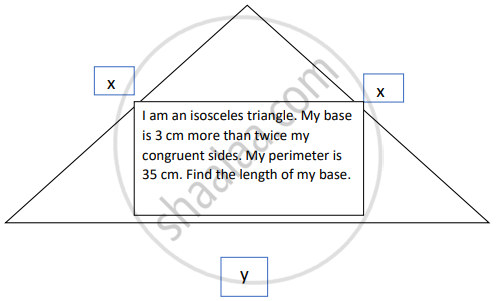
Solve: 99x + 101y = 499; 101x + 99y = 501
The semi perimeter of a rectangular shape garden is 36 m. The length of the garden is 4 m more than its breadth. Find the length and the breadth of the garden.
Evaluate: (1004)3
