Advertisements
Advertisements
Question
Sanjay gets fixed monthly income. Every year there is a certain increment in his salary. After 4 years, his monthly salary was Rs. 4500 and after 10 years his monthly salary became 5400 rupees, then find his original salary and yearly increment.
Advertisements
Solution
Let the fixed monthly income be Rs x.
Annual increment be Rs y.
After 4 years, his monthly salary was Rs. 4500
Monthly salary + annual increment of 4 years = 4500
x + 4y = 4500 ...(I)
After 10 years his monthly salary became 5400 rupees
Monthly salary + annual increment of 10 years = 5400
x + 10y = 5400 ...(II)
Subtracting I from II
x + 4y = 4500
x + 10y = 5400
− − −
−6y = −900
∴ y = 150
put y = 150 in equation (I)
x + 4y = 4500
x + 4 × 150 = 4500
x + 600 = 4500
x = 4500 − 600
x = 3900
Thus, the monthly salary = Rs. 3900
Annual increment = Rs.150
APPEARS IN
RELATED QUESTIONS
Solve the following system of linear equations by using the method of elimination by equating the coefficients √3x – √2y = √3 = ; √5x – √3y = √2
Solve the following system of linear equations :
2(ax – by) + (a + 4b) = 0
2(bx + ay) + (b – 4a) = 0
Solve the following pair of linear equation by the elimination method and the substitution method:
x + y = 5 and 2x – 3y = 4
Solve the following pair of linear equation by the elimination method and the substitution method:
3x + 4y = 10 and 2x – 2y = 2
Form the pair of linear equation in the following problem, and find its solution (if they exist) by the elimination method:
The sum of the digits of a two-digit number is 9. Also, nine times this number is twice the number obtained by reversing the order of the digits. Find the number.
Form the pair of linear equation in the following problem, and find its solution (if they exist) by the elimination method:
A lending library has a fixed charge for the first three days and an additional charge for each day thereafter. Saritha paid Rs 27 for a book kept for seven days, while Susy paid Rs 21 for the book she kept for five days. Find the fixed charge and the charge for each extra day.
Out of 1900 km, Vishal travelled some distance by bus and some by aeroplane. The bus travels with an average speed of 60 km/hr and the average speed of the aeroplane is 700 km/hr. It takes 5 hours to complete the journey. Find the distance, Vishal travelled by bus.
The sum of a two-digit number and the number formed by reversing the order of digit is 66. If the two digits differ by 2, find the number. How many such numbers are there?
Solve the following simultaneous equation.
2x - y = 5 ; 3x + 2y = 11
Solve the following simultaneous equation.
x − 2y = −2 ; x + 2y = 10
By equating coefficients of variables, solve the following equations.
3x - 4y = 7; 5x + 2y = 3
A fraction becomes `1/3` when 2 is subtracted from the numerator and it becomes `1/2` when 1 is subtracted from the denominator. Find the fraction.
The difference between an angle and its complement is 10° find measure of the larger angle.
Complete the activity.
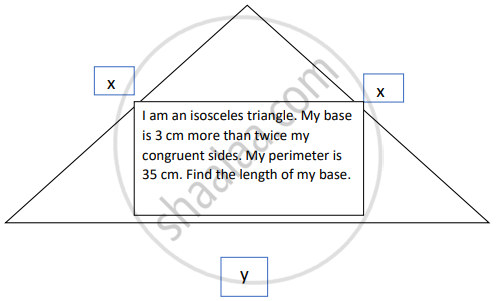
The angles of a triangle are x, y and 40°. The difference between the two angles x and y is 30°. Find x and y.
The age of the father is twice the sum of the ages of his two children. After 20 years, his age will be equal to the sum of the ages of his children. Find the age of the father.
The angles of a cyclic quadrilateral ABCD are ∠A = (6x + 10)°, ∠B = (5x)°, ∠C = (x + y)°, ∠D = (3y – 10)°. Find x and y, and hence the values of the four angles.
A 2-digit number is such that the product of its digits is 24. If 18 is subtracted from the number, the digits interchange their places. Find the number.
