Advertisements
Advertisements
Question
Show that the points A(1, 2), B(1, 6), C(1 + 2`sqrt3`, 4) are vertices of an equilateral triangle.
Advertisements
Solution
The given points are A(1, 2), B(1, 6), C(1 + 2`sqrt3`, 4).
`"Distance between" = sqrt((x_2 - x_1)^2 + (y_2 - y_1)^2)`
By distance formula,
AB = `sqrt((1 - 1)^2 + (6 - 2)^2)`
∴ AB = `sqrt((0)^2 + (4)^2)`
∴ AB = `sqrt(0 + 16)`
∴ AB = `sqrt(16)`
∴ AB = 4 ...(1)
BC = `sqrt((1 + 2sqrt3 - 1)^2 + (4 - 6)^2)`
∴ BC = `sqrt((2sqrt3)^2 + (-2)^2)`
∴ BC = `sqrt(12 + 4)`
∴ BC = `sqrt(16)`
∴ BC = 4 ...(2)
AC = `sqrt((1 + 2sqrt3 - 1)^2 + (4 - 2)^2)`
∴ AC = `sqrt((2sqrt3)^2 + (2)^2)`
∴ AC = `sqrt(12 + 4)`
∴ AC = `sqrt(16)`
∴ AC = 4 ...(3)
From (1), (2) and (3)
∴ AB = BC = AC = 4
Since, all the sides of equilateral triangle are congruent.
∴ ΔABC is an equilateral triangle.
The points A, B and C are the vertices of an equilateral triangle.
RELATED QUESTIONS
Prove that the points (–3, 0), (1, –3) and (4, 1) are the vertices of an isosceles right angled triangle. Find the area of this triangle
Find the distance between the points (0, 0) and (36, 15). Can you now find the distance between the two towns A and B discussed in Section 7.2.
Show that the points A (1, –2), B (3, 6), C (5, 10) and D (3, 2) are the vertices of a parallelogram.
Using the distance formula, show that the given points are collinear:
(–2, 5), (0, 1) and (2, –3)
For what values of k are the points (8, 1), (3, –2k) and (k, –5) collinear ?
Find x if distance between points L(x, 7) and M(1, 15) is 10.
If A and B are the points (−6, 7) and (−1, −5) respectively, then the distance
2AB is equal to
AB and AC are the two chords of a circle whose radius is r. If p and q are
the distance of chord AB and CD, from the centre respectively and if
AB = 2AC then proove that 4q2 = p2 + 3r2.
Distance of point (−3, 4) from the origin is ______.
Find the distance between the following pairs of point in the coordinate plane :
(13 , 7) and (4 , -5)
Find the value of m if the distance between the points (m , -4) and (3 , 2) is 3`sqrt 5` units.
Find the relation between a and b if the point P(a ,b) is equidistant from A (6,-1) and B (5 , 8).
Find the relation between x and y if the point M (x,y) is equidistant from R (0,9) and T (14 , 11).
A(-2, -3), B(-1, 0) and C(7, -6) are the vertices of a triangle. Find the circumcentre and the circumradius of the triangle.
Prove that the points (0 , 2) , (1 , 1) , (4 , 4) and (3 , 5) are the vertices of a rectangle.
Show that the points A (5, 6), B (1, 5), C (2, 1) and D (6, 2) are the vertices of a square ABCD.
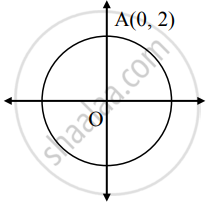
Seg OA is the radius of a circle with centre O. The coordinates of point A is (0, 2) then decide whether the point B(1, 2) is on the circle?
The distance between the points (0, 5) and (–5, 0) is ______.
The centre of a circle is (2a, a – 7). Find the values of a if the circle passes through the point (11, –9) and has diameter `10sqrt(2)` units.
