Advertisements
Advertisements
प्रश्न
Show that the points A(1, 2), B(1, 6), C(1 + 2`sqrt3`, 4) are vertices of an equilateral triangle.
Advertisements
उत्तर
The given points are A(1, 2), B(1, 6), C(1 + 2`sqrt3`, 4).
`"Distance between" = sqrt((x_2 - x_1)^2 + (y_2 - y_1)^2)`
By distance formula,
AB = `sqrt((1 - 1)^2 + (6 - 2)^2)`
∴ AB = `sqrt((0)^2 + (4)^2)`
∴ AB = `sqrt(0 + 16)`
∴ AB = `sqrt(16)`
∴ AB = 4 ...(1)
BC = `sqrt((1 + 2sqrt3 - 1)^2 + (4 - 6)^2)`
∴ BC = `sqrt((2sqrt3)^2 + (-2)^2)`
∴ BC = `sqrt(12 + 4)`
∴ BC = `sqrt(16)`
∴ BC = 4 ...(2)
AC = `sqrt((1 + 2sqrt3 - 1)^2 + (4 - 2)^2)`
∴ AC = `sqrt((2sqrt3)^2 + (2)^2)`
∴ AC = `sqrt(12 + 4)`
∴ AC = `sqrt(16)`
∴ AC = 4 ...(3)
From (1), (2) and (3)
∴ AB = BC = AC = 4
Since, all the sides of equilateral triangle are congruent.
∴ ΔABC is an equilateral triangle.
The points A, B and C are the vertices of an equilateral triangle.
संबंधित प्रश्न
If two vertices of an equilateral triangle be (0, 0), (3, `sqrt3`), find the third vertex using distance formula.
Find the distance between the following pairs of points:
(−5, 7), (−1, 3)
Find a relation between x and y such that the point (x, y) is equidistant from the point (3, 6) and (–3, 4).
If a ≠ b ≠ 0, prove that the points (a, a2), (b, b2) (0, 0) will not be collinear.
Using the distance formula, show that the given points are collinear:
(–2, 5), (0, 1) and (2, –3)
AB and AC are the two chords of a circle whose radius is r. If p and q are
the distance of chord AB and CD, from the centre respectively and if
AB = 2AC then proove that 4q2 = p2 + 3r2.
The perimeter of a triangle with vertices (0, 4), (0, 0) and (3, 0) is ______.
Find the distance between the following pairs of point in the coordinate plane :
(7 , -7) and (2 , 5)
Prove that the following set of point is collinear :
(5 , 1),(3 , 2),(1 , 3)
The centre of a circle passing through P(8, 5) is (x+l , x-4). Find the coordinates of the centre if the diameter of the circle is 20 units.
ABC is an equilateral triangle . If the coordinates of A and B are (1 , 1) and (- 1 , -1) , find the coordinates of C.
Find a point on the y-axis which is equidistant from the points (5, 2) and (-4, 3).
Show that the points A (5, 6), B (1, 5), C (2, 1) and D (6, 2) are the vertices of a square ABCD.
Find the distance of the following points from origin.
(a+b, a-b)
KM is a straight line of 13 units If K has the coordinate (2, 5) and M has the coordinates (x, – 7) find the possible value of x.
Find distance between point A(7, 5) and B(2, 5).
Find distance CD where C(–3a, a), D(a, –2a).
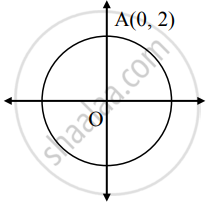
Seg OA is the radius of a circle with centre O. The coordinates of point A is (0, 2) then decide whether the point B(1, 2) is on the circle?
The point P(–2, 4) lies on a circle of radius 6 and centre C(3, 5).
If (a, b) is the mid-point of the line segment joining the points A(10, –6) and B(k, 4) and a – 2b = 18, find the value of k and the distance AB.
