Advertisements
Advertisements
प्रश्न
Show that the point (11, –2) is equidistant from (4, –3) and (6, 3).
Advertisements
उत्तर
Let P(x1, y1) = P(11, –2), Q(x2, y2) = Q(4, –3), R(x3, y3) = R(6, 3)
By distance formula,
d(P, Q) = `sqrt((x_2 - x_1)^2 + (y_2 - y_1)^2`
= `sqrt((4 - 11)^2 + [-3 - (-2)]^2`
= `sqrt((-7)^2 + (-1)^2`
= `sqrt(49 + 1)`
= `sqrt(50)`
= `5sqrt(2)`
And
d(P, R) = `sqrt((x_3 - x_1)^2 + (y_3 - y_1)^2`
= `sqrt((6 - 11)^2 + [3 - (-2)]^2`
= `sqrt((-5)^2 + (5)^2`
= `sqrt(25 + 25)`
= `sqrt(50)`
= `5sqrt(2)`
Here, d(P, Q) = d(P, R)
∴ Point (11, –2) is equidistant from (4, –3) and (6, 3).
APPEARS IN
संबंधित प्रश्न
Find the distance between the points:
A(–6, –4) and B(9, –12)
If P(x, y) is equidistant from the points A(7, 1) and B(3, 5), find the relation between x and y.
Find the distance between the following pair of point.
P(–5, 7), Q(–1, 3)
Find the distances between the following point.
P(–6, –3), Q(–1, 9)
Find the distance between the following pairs of point in the coordinate plane :
(13 , 7) and (4 , -5)
Find the distance between the following point :
(Sin θ - cosec θ , cos θ - cot θ) and (cos θ - cosec θ , -sin θ - cot θ)
Find the value of a if the distance between the points (5 , a) and (1 , 5) is 5 units .
Find the value of m if the distance between the points (m , -4) and (3 , 2) is 3`sqrt 5` units.
Find the relation between a and b if the point P(a ,b) is equidistant from A (6,-1) and B (5 , 8).
Find the coordinates of O, the centre passing through A( -2, -3), B(-1, 0) and C(7, 6). Also, find its radius.
x (1,2),Y (3, -4) and z (5,-6) are the vertices of a triangle . Find the circumcentre and the circumradius of the triangle.
Find the distance between the origin and the point:
(-5, -12)
Find the co-ordinates of points on the x-axis which are at a distance of 17 units from the point (11, -8).
A point P lies on the x-axis and another point Q lies on the y-axis.
Write the ordinate of point P.
Given A = (3, 1) and B = (0, y - 1). Find y if AB = 5.
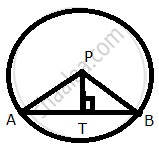
Point P (2, -7) is the centre of a circle with radius 13 unit, PT is perpendicular to chord AB and T = (-2, -4); calculate the length of AB.
The points A (3, 0), B (a, -2) and C (4, -1) are the vertices of triangle ABC right angled at vertex A. Find the value of a.
Find distance between point A(7, 5) and B(2, 5).
The distance of the point (α, β) from the origin is ______.
What type of a quadrilateral do the points A(2, –2), B(7, 3), C(11, –1) and D(6, –6) taken in that order, form?
