Advertisements
Advertisements
प्रश्न
Find distance CD where C(–3a, a), D(a, –2a).
Advertisements
उत्तर
Let C(x1, y1) and D(x2, y2) be the given points.
∴ x1 = –3a, y1 = a, x2 = a, y2 = –2a
By distance formula,
d(C, D) = `sqrt((x_2 - x_1)^2 + (y_2 - y_1)^2`
= `sqrt([a - (-3a)]^2 + (-2a - a)^2`
= `sqrt((a + 3a)^2 + (-2a - a)^2`
= `sqrt((4a)^2 + (-3a)^2`
= `sqrt(16a^2 + 9a^2)`
= `sqrt(25a^2)`
∴ d(C, D) = 5a units
संबंधित प्रश्न
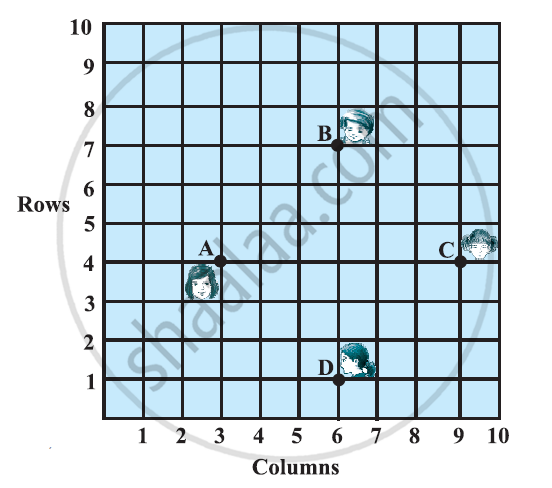
In a classroom, 4 friends are seated at the points A, B, C and D as shown in the following figure. Champa and Chameli walk into the class and after observing for a few minutes, Champa asks Chameli, “Don’t you think ABCD is a square?” Chameli disagrees.
Using distance formula, find which of them is correct.
Find the point on the x-axis which is equidistant from (2, –5) and (–2, 9).
Find the value of a when the distance between the points (3, a) and (4, 1) is `sqrt10`.
A(–8, 0), B(0, 16) and C(0, 0) are the vertices of a triangle ABC. Point P lies on AB and Q lies on AC such that AP : PB = 3 : 5 and AQ : QC = 3 : 5. Show that : PQ = `3/8` BC.
Using the distance formula, show that the given points are collinear:
(–2, 5), (0, 1) and (2, –3)
Find the distance between the following pair of point.
P(–5, 7), Q(–1, 3)
Find the distance between the following pair of point in the coordinate plane.
(1 , 3) and (3 , 9)
PQR is an isosceles triangle . If two of its vertices are P (2 , 0) and Q (2 , 5) , find the coordinates of R if the length of each of the two equal sides is 3.
From the given number line, find d(A, B):

Find the distance between the points (a, b) and (−a, −b).
The distance between the points (3, 1) and (0, x) is 5. Find x.
Find the coordinates of the points on the y-axis, which are at a distance of 10 units from the point (-8, 4).
The centre of a circle is (2x - 1, 3x + 1). Find x if the circle passes through (-3, -1) and the length of its diameter is 20 unit.
The length of line PQ is 10 units and the co-ordinates of P are (2, -3); calculate the co-ordinates of point Q, if its abscissa is 10.
The points A (3, 0), B (a, -2) and C (4, -1) are the vertices of triangle ABC right angled at vertex A. Find the value of a.
The distance between the point P(1, 4) and Q(4, 0) is ______.
The distance of the point P(–6, 8) from the origin is ______.
The points (– 4, 0), (4, 0), (0, 3) are the vertices of a ______.
Find the points on the x-axis which are at a distance of `2sqrt(5)` from the point (7, – 4). How many such points are there?
