Advertisements
Advertisements
Question
Show that the point (11, –2) is equidistant from (4, –3) and (6, 3).
Advertisements
Solution
Let P(x1, y1) = P(11, –2), Q(x2, y2) = Q(4, –3), R(x3, y3) = R(6, 3)
By distance formula,
d(P, Q) = `sqrt((x_2 - x_1)^2 + (y_2 - y_1)^2`
= `sqrt((4 - 11)^2 + [-3 - (-2)]^2`
= `sqrt((-7)^2 + (-1)^2`
= `sqrt(49 + 1)`
= `sqrt(50)`
= `5sqrt(2)`
And
d(P, R) = `sqrt((x_3 - x_1)^2 + (y_3 - y_1)^2`
= `sqrt((6 - 11)^2 + [3 - (-2)]^2`
= `sqrt((-5)^2 + (5)^2`
= `sqrt(25 + 25)`
= `sqrt(50)`
= `5sqrt(2)`
Here, d(P, Q) = d(P, R)
∴ Point (11, –2) is equidistant from (4, –3) and (6, 3).
APPEARS IN
RELATED QUESTIONS
Show that the points (a, a), (–a, –a) and (– √3 a, √3 a) are the vertices of an equilateral triangle. Also find its area.
Check whether (5, -2), (6, 4) and (7, -2) are the vertices of an isosceles triangle.
Determine if the points (1, 5), (2, 3) and (−2, −11) are collinear.
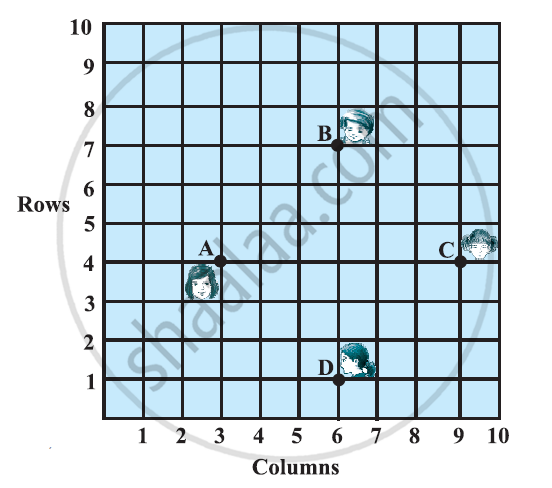
In a classroom, 4 friends are seated at the points A, B, C and D as shown in the following figure. Champa and Chameli walk into the class and after observing for a few minutes, Champa asks Chameli, “Don’t you think ABCD is a square?” Chameli disagrees.
Using distance formula, find which of them is correct.
Given a line segment AB joining the points A(–4, 6) and B(8, –3). Find
1) The ratio in which AB is divided by y-axis.
2) Find the coordinates of the point of intersection.
3) The length of AB.
Find the centre of the circle passing through (6, -6), (3, -7) and (3, 3)
Find the distance between the points:
A(–6, –4) and B(9, –12)
Determine whether the point is collinear.
R(0, 3), D(2, 1), S(3, –1)
Find x if distance between points L(x, 7) and M(1, 15) is 10.
Find the distance of the following point from the origin :
(6 , 8)
Find the coordinate of O , the centre of a circle passing through A (8 , 12) , B (11 , 3), and C (0 , 14). Also , find its radius.
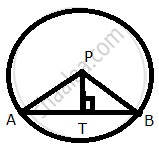
Point P (2, -7) is the centre of a circle with radius 13 unit, PT is perpendicular to chord AB and T = (-2, -4); calculate the length of AB.
Calculate the distance between A (7, 3) and B on the x-axis whose abscissa is 11.
If the length of the segment joining point L(x, 7) and point M(1, 15) is 10 cm, then the value of x is ______.
Show that the point (0, 9) is equidistant from the points (–4, 1) and (4, 1).
Show that A(1, 2), (1, 6), C(1 + 2`sqrt(3)`, 4) are vertices of an equilateral triangle.
If the distance between the points (4, P) and (1, 0) is 5, then the value of p is ______.
The points (– 4, 0), (4, 0), (0, 3) are the vertices of a ______.
Ayush starts walking from his house to office. Instead of going to the office directly, he goes to a bank first, from there to his daughter’s school and then reaches the office. What is the extra distance travelled by Ayush in reaching his office? (Assume that all distances covered are in straight lines). If the house is situated at (2, 4), bank at (5, 8), school at (13, 14) and office at (13, 26) and coordinates are in km.
What is the distance of the point (– 5, 4) from the origin?
