Advertisements
Advertisements
Question
Show that none of the following is an identity:
`cos^2theta + cos theta = 1`
Advertisements
Solution
`cos^2theta + cos theta =1`
LHS = `cos^2 theta + cos theta`
=`1- sin^2 theta + cos theta `
=` 1- ( sin^2 theta - cos theta )`
Since LHS ≠ RHS, this not an identity.
APPEARS IN
RELATED QUESTIONS
Prove the following identities:
`(i) cos4^4 A – cos^2 A = sin^4 A – sin^2 A`
`(ii) cot^4 A – 1 = cosec^4 A – 2cosec^2 A`
`(iii) sin^6 A + cos^6 A = 1 – 3sin^2 A cos^2 A.`
Prove that `(sin theta)/(1-cottheta) + (cos theta)/(1 - tan theta) = cos theta + sin theta`
Prove the following trigonometric identities.
`sqrt((1 - cos theta)/(1 + cos theta)) = cosec theta - cot theta`
Prove the following trigonometric identities.
`(tan^3 theta)/(1 + tan^2 theta) + (cot^3 theta)/(1 + cot^2 theta) = sec theta cosec theta - 2 sin theta cos theta`
Prove the following trigonometric identities.
(sec A + tan A − 1) (sec A − tan A + 1) = 2 tan A
Given that: (1 + cos α) (1 + cos β) (1 + cos γ) = (1 − cos α) (1 − cos β) (1 − cos γ)
Show that one of the values of each member of this equality is sin α sin β sin γ
Prove the following identities:
cosec A(1 + cos A) (cosec A – cot A) = 1
Show that : `sinA/sin(90^circ - A) + cosA/cos(90^circ - A) = sec A cosec A`
Prove the following identities:
`((cosecA - cotA)^2 + 1)/(secA(cosecA - cotA)) = 2cotA`
`sin theta / ((1+costheta))+((1+costheta))/sin theta=2cosectheta`
If`( 2 sin theta + 3 cos theta) =2 , " prove that " (3 sin theta - 2 cos theta) = +- 3.`
Prove that:
`(sin^2θ)/(cosθ) + cosθ = secθ`
If sin θ = `11/61`, find the values of cos θ using trigonometric identity.
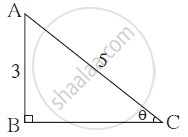
From the figure find the value of sinθ.
\[\frac{1 + \tan^2 A}{1 + \cot^2 A}\]is equal to
Prove the following identity :
`1/(sinA + cosA) + 1/(sinA - cosA) = (2sinA)/(1 - 2cos^2A)`
If x = r sinA cosB , y = r sinA sinB and z = r cosA , prove that `x^2 + y^2 + z^2 = r^2`
If `sqrt(3)` sin θ – cos θ = θ, then show that tan 3θ = `(3tan theta - tan^3 theta)/(1 - 3 tan^2 theta)`
If sec θ = `25/7`, find the value of tan θ.
Solution:
1 + tan2 θ = sec2 θ
∴ 1 + tan2 θ = `(25/7)^square`
∴ tan2 θ = `625/49 - square`
= `(625 - 49)/49`
= `square/49`
∴ tan θ = `square/7` ........(by taking square roots)
Prove that `(1 + tan^2 A)/(1 + cot^2 A)` = sec2 A – 1
