Advertisements
Advertisements
Questions
Show that intensity of electric field at a point in broadside position of an electric dipole is given by:
E = `(1/(4 pi epsilon_0)) p/((r^2 + l^2)^(3//2))`
Where the terms have their usual meaning.
Show that intensity of electric field E at a point in broadside on position is given by:
E = `(1/(4 pi epsilon_0)) p/((r^2 + l^2)^(3//2))`,
where the terms have their usual meaning.
Advertisements
Solution
Consider a dipole of length 2l and moment `vec p`.
From the figure, resultant electric field intensity at C:
`vec E = vec E_A + vec E_B`
`|vec E_A| = 1/(4 pi epsilon_0) q/(r^2 + l^2)`
`|vec E_B| = 1/(4 pi epsilon_0) q/(r^2 + l^2)`
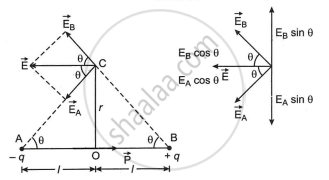
Sine components of `vec E_A` and `vec E_B` get cancelled each other as `|vec E_A| = |vec E_B|`.
The cosine components get added up to give the resultant field.
i.e., E = EA cos θ + EB cos θ
= `1/(4 pi epsilon_0) * q/(r^2 + l^2) cos theta + 1/(4 pi epsilon_0) * q/(r^2 + l^2) cos theta`
= `2 * 1/(4 pi epsilon_0) * q/(r^2 + l^2) cos theta`
= `2 xx 1/(4 pi epsilon_0) * q/(r^2 + l^2) xx l/(r^2 + l^2)^(1//2)`
= `1/(4 pi epsilon_0) (q(2 l))/((r^2 + l^2)^(3//2))`
E = `1/(4 pi epsilon_0) p/((r^2 + l^2)^(3//2))` ...[as p = q(2l)]
The above expression gives the magnitude of the field. The direction of the electric field E at C is opposite to the direction of the dipole moment `vec p`.
RELATED QUESTIONS
A system has two charges qA = 2.5 × 10⁻⁷ C and qB = −2.5 × 10⁻⁷ C located at points A: (0, 0, −15 cm) and B: (0, 0, +15 cm), respectively. What are the total charge and electric dipole moment of the system?
- Define torque acting on a dipole of dipole moment \[\vec{p}\] placed in a uniform electric field \[\vec{E}\] Express it in the vector from and point out the direction along which it acts. Express it in the vector from and point out the direction along which it acts.
- What happens if the field is non-uniform?
- What would happen if the external field
\[\vec{E}\] is increasing (i) parallel to \[\vec{p}\] and (ii) anti-parallel to \[\vec{p}\]?
Define electric dipole moment. Is it a scalar or a vector? Derive the expression for the electric field of a dipole at a point on the equatorial plane of the dipole.
Electric charges q, q, - 2q are placed at the comers of an equilateral triangle ABC of side l. The magnitude of electric dipole moment of the system is ____________.
An electric dipole of moment p is placed parallel to the uniform electric field. The amount of work done in rotating the dipole by 90° is ____________.
The ratio of the weight of a man in a stationary lift and in a lift accelerating downwards with a uniform acceleration α is 3 : 2. The acceleration of the lift is:
The region surrounding a stationary electric dipole has ______
What work must be done to rotate an electric dipole through an angle θ with the electric field, if an electric dipole of moment p is placed in a uniform electric field E with p parallel to E?
