Advertisements
Advertisements
Question

Advertisements
Solution 1
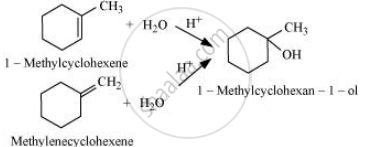
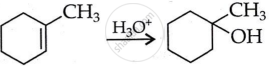
The given alcohols can be synthesised by applying Markovnikov’s rule of acid-catalysed hydration of appropriate alkenes.
Solution 2
APPEARS IN
RELATED QUESTIONS
How will you convert: Propene to Propan-2-ol?
Write the structures of the main products when acetone (CH3 − CO − CH3) reacts with the following reagents :
CH3MgBr and then H3O+
Show how is the following alcohol prepared by the reaction of a suitable Grignard reagent on methanal?
\[\begin{array}{cc}
\ce{CH3 - CH - CH2OH}\\
|\phantom{........}\\
\ce{CH3}\phantom{....}\\
\end{array}\]
Show how is the following alcohol prepared by the reaction of a suitable Grignard reagent on methanal?

Write the mechanism of hydration of ethene to yield ethanol.
Name the reagent used in the following reaction:
Dehydration of propan-2-ol to propene.
Ketones react with Grignard reagent to produce ____________.
Monochlorination of toluene in sunlight followed by hydrolysis by aq. \[\ce{NaOH}\] yields.
How can propan-2-one be converted into tert- butyl alcohol?
Explain a process in which a biocatalyst is used in industrial preparation of a compound known to you.
The Wittig reaction is a reaction between a carbonyl compound (aldehyde or ketone only) and a species known as a phosphoniumylide. What is the expected final product in the Wittig reaction?
Magnesium wire continues to burn in the atmosphere of CO2 because
Most readily hydrolysed halide is:-
When alcohol react with concentrated H2SO4 intermediate compound formed is
When glycol is heated with dicorboxylic acid the product are
Alkaline hydrolysis of an alkyl halide can be preferably carried out using ______.
An aldehyde isomeric with allyl alcohol gives phenyl hydrazone. Pick out a ketone that too gives a phenyl hydrazone containing the same percentage of nitrogen.
Given below are two statements:
Statement I: On heating with KHSO4, glycerol is dehydrated and acrolein is formed.
Statement II: Acrolein has a fruity odour and can be used to test glycerol's presence.
Choose the correct option.
Write the mechanism of acid dehydration of ethanol to yield ethene.
