Advertisements
Advertisements
Question
Draw a ray diagram for concave mirror when the object is between centre of curvature and focus.
Advertisements
Solution
When the object is between the centre of curvature and the focus of a concave mirror
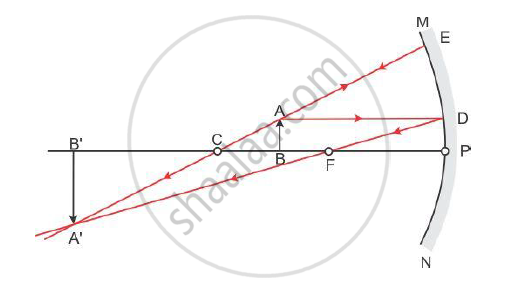
Here, Object AB is kept between C and F
First, we draw a ray parallel to principal axis
So, it passes through focus after reflection
We draw another ray which passes through Center of Curvature
So, the ray will go back along the same path after reflection
Where both reflected rays meet is point A'
And the image formed is A'B'
This image is formed between beyong Center(C)
We can say that
Image is in Front of the mirror (Real image)
Image is Inverted
Image is larger than the object (Magnified)
APPEARS IN
RELATED QUESTIONS
If the image formed by a mirror for all positions of the object placed in front of it is always erect and diminished, what type of mirror is it? Draw a ray diagram to justify your answer. Where and why do we generally use this type of mirror?
Draw a ray diagram to show the path of the reflected ray corresponding to an incident ray of light parallel to the principal axis of a convex mirror and show the angle of incidence and angle of reflection on it.
To determine the approximate value of the focal length of a given concave mirror, you focus the image of a distant object formed by the mirror on a screen. The image obtained on the serene, as compared to the object is always:
(a) Laterally inverted and diminished
(b) Inverted and diminished
(c) Erect and diminished
(d) Erect and highly diminished
A student obtained a sharp image of a candle flame placed at the distant end of the laboratory table on a screen using a concave mirror to determine its focal length. The teacher suggested him to focus a distant building, about 1 km away from the laboratory, for getting more correct value of the focal length. In order to focus the distant building on the same screen, the student should slightly move the
(a) mirror away from the screen
(b) screen away from the mirror
(c) screen towards the mirror
(d) screen towards the building
The angle between an incident ray and the plane mirror is 30°. The total angle between the incident ray and reflected ray will be:
(a) 30°
(b) 60°
(c) 90°
(d) 120°
Explain why, a ray of light passing through the centre of curvature of a concave mirror gets reflected back along the same path.
Name the type of mirror used by dentists. How does it help?
Draw ray-diagrams to show the formation of images when the object is places in front of a concave mirror (converging mirror):
(i) between its pole and focus
(ii) between its centre of curvature and focus
In the concave reflector of a torch, the bulb is placed:
(a) between the pole and focus of reflector
(b) at the focus of reflector
(c) between focus and centre of curvature of reflector
(d) at the centre of curvature of reflector
According to New Cartesian Sign Convention:
(a) focal length of concave mirror is positive and that of convex mirror is negative
(b) focal length of both concave and convex mirrors is positive
(c) focal length of both concave and convex mirrors is negative
(d) focal length of concave mirror is negative and that of convex mirror is positive
Write down a formula for the magnification produced by a concave mirror.
in terms of height of object and height of image
The mirror which can form a magnified image of an object is:
(a) convex mirror
(b) plane mirror
(c) concave mirror
(d) both convex and concave mirror
Radius of curvature of a spherical mirror is ............. its focal length.
The image formed by a concave mirror is of the same size as the object, if the object is placed
Draw a ray diagram to show the formation of image of an object placed between the pole and focus of a concave mirror. State the position, size and nature of the image.
State two uses of a concave mirror.
A concave mirror of focal length 20 cm forms an image having twice the size of object. For the virtual position of object, the position of object will be at ______.
You are provided with a convex mirror, a concave mirror, a convex lens and a concave lens. You can get an inverted image from
Which type of mirror is used in the following?
Head lamps of a car
