Advertisements
Advertisements
Question
Read Sheela's notice. Discuss the questions that follow.
|
Notice The Drama Committee will meet in the classroom on Monday, at two o’clock. We’ll plan a play for our Annual Day. Will each one of you please bring a play? SHEELA |
- Who was to meet?
- When were they to meet?
- Where were they to meet?
- What were they to do?
Advertisements
Solution
-
The Drama Committee was to meet.
- They were to meet on Monday at 2’o clock.
- They were meet in the classroom.
- They were to plan a play for their Annual Day.
APPEARS IN
RELATED QUESTIONS
Read the following extract and complete the note with the help of the clues provided :
Vitamins are either fat-soluble (A, D, E, K) or water-soluble (B vitamins, including niacin, folic acid and riboflavin, and vitamin C). They consist mainly of the elements nitrogen, oxygen, carbon and hydrogen. Fat-soluble vitamins are stored in bod)' fat, while water-soluble vita1nins are used or quickly excreted in the urine.
Vitamin A is essential for the eyes, skin, hair, and bones; the B vitamins help enzymes to function; C is essential for the formation of collagen; D helps the body absorb calcium; E prevents cell damage, and K helps blood clotting. Most vitamins cannot be produced by the body and so must be obtained directly from food.
VITAMINS
| Vitamins are obtained from | |
| B Vitamins | Fat-soluble |
| Vitamins consist of | 1. 2. Oxygen 3. 4. Hydrogen |
| Vitamin A B C D E K |
Essential for eyes, skin, etc. Formation of collagen Prevents cell damage |
Is there any relevance of this poem to the present scenario?
Given below is an interesting combination of words. Explain why they have been used together.
ghostly dust devils
Identify the stanzas that talks of each of the following.
| Individuality | rationalism | hypocrisy |
Discuss the following in pairs or in small groups.
The cleverest of criminals leave behind clues to their crime.
Discuss in pairs
Chako's firmness in dealing with the irrational behaviour of his father.
Notice the use of ‘there’ in the following sentences.
-
There was a big crowd at the fair.
-
There were many things I’d have liked to buy.
Now rewrite the following sentences using ‘there’ in the beginning. Look at the following examples.
-
I can do nothing to help you.
-
There is nothing I can do to help you.
-
A man at the door is asking to see you.
-
There is a man at the door asking to see you.
1. This park has beautiful roses.
2. Your story has no fun in it.
3. We have no secrets between us.
4. My village has two primary schools.
5. This problem can be solved in two ways.
Search in your college library or on the internet for at least five stories where a king or any great person has forgiven a losing king, culprit, or offender. There are many such stories that you might have read in your history books. One such story is of Alexander and Porus. Find at least five stories and write their summarised version in your notebook.
Discuss with your partner on the following topic. Express your views and opinions in favour of and against the topic.
Are college council elections essential in Jr. Colleges?
Write a letter to your friend about the Great Indian Bustard. You may use the following points:
- Why we need to protect the bird.
- What you plan to do to help the bird.
Write a letter to your Class Teacher or the Principal of your school to make the following request.
Your school library subscribes to a few newspapers. Your class wants old issues of the newspapers for some educational activity in the classroom. You are required to make cuttings / news clipping. Therefore, the papers cannot be returned to the library but you will use them in a responsible manner. Use the format of a formal letter given below.
Read the following headline and write a news report. Follow the steps as given.
- Headline: ‘Tiger attacks 8 years old at Rajiv Gandhi National Park.’
- Date line: ....................
- Leadline: ....................
- Body of the Report (Use only 3rd person pronouns/Passive voice): ....................
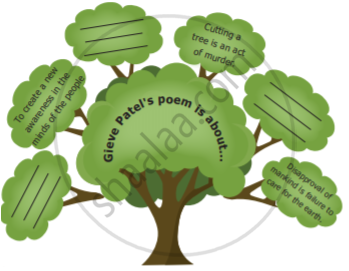
Based on the reading of the poem, complete the web chart given below.
It is very late at night and your father hasn’t returned from the office. ______
You are the receptionist of your school. Your Head master instructs you to send a message to all the parents of class ten to attend a PTA (Parent-Teacher Association) meet which is to be held on 22.12.2019
|
______________________________ ______________________________ ______________________________ ______________________________ |
The travellers rested under the ______ of trees.
Now complete the following, in the same way, using the words juicy or exciting. The order may vary according to your choice.
apple ______
orange ______
sugarcane ______
rock climbing ______
skiing ______
river rafting ______
What was her first impression of America?
Describe Mary Kom’s personal experiences during her first International Championship match from the time of selection to winning the medal.
Write the full form for the following.
weren’t - ______
