Advertisements
Advertisements
Question
Read carefully the terms given below. Which of the following set is the correct combination of organs that do not carry out any digestive functions?
Options
Oesophagus, Large Intestine, Rectum
Buccal cavity, Oesophagus, Rectum
Buccal cavity, Oesophagus, Large Intestine
Small Intestine, Large Intestine, Rectum
Advertisements
Solution
Oesophagus, Large Intestine, Rectum
Explanation:
Oesophagus gently pushes food down to the stomach in a wave like action called peristalsis. No digestion takes place in the oesophagus.
In large intestine, undigested food enters where water is absorbed from it. No digestion takes place in the large intestine.
In rectum, semi-solid residue is stored and is finally thrown out of the body through the anus in the form of faeces. No digestion takes place in the rectum.
APPEARS IN
RELATED QUESTIONS
Which part of the digestive canal is involved in:
Killing of bacteria ______.
Name the enzyme present in human saliva. What type of food material is digested by this enzyme?
Define holozoic nutrition.
The process of digestion of food in humans begins in ______.
What is roughage? Give two examples.
Draw a labelled diagram to show the internal structure of a mammalian tooth with two roots.
Study the diagram given below and then answer the question that follows:
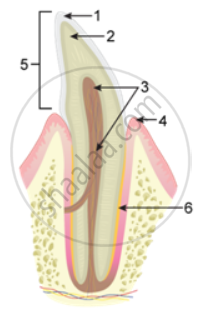
Name the parts labelled 1, 2, 3, 4, 5 and 6.
Study the diagram given below and then answer the question that follows:
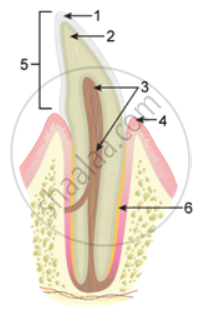
Give the total number of the type of tooth mentioned in '1' above, in the mouth of an adult and state its function.
Study the following dental formula and then answer the question that follow:
`"i" 3/4 "c" 0/0 "pm" 0/1 "m" 1/1`
Name an animal possessing such a dentition.
Write true or false for the below statement. Rewrite the false statements correctly.
The pancreas secretes bile juice
Differentiate between
Digestion and Absorption
Describe the human salivary gland.
The question has four options. Choose the correct answer:
Uvula can close the opening of
Pushing forward the food that has been chewed is the function of the ______.
Write down the explanation.
Explain why human dentition is considered as thecodont, diphydont and heterodont.
Appendix is a vestigial organ in humans and functional in herbivorous animals for the digestion of ____________.
A calcified connective tissue from which the basic shape of the tooth is derived is known as ______.
Match the two columns and select correct option.
| Column - I | Column - II | ||
| i. | Sphincter of Oddi | a. | Oesophagus and stomach |
| ii. |
Ileo-caecal sphincter |
b. | Stomach and small intestine |
| iii. | Pyloric sphincter | c | Ileum and caecum |
| iv. |
Gastro-oesophageal sphincter |
d. | Opening of hepato- pancreatic duct |
Match the following:
| 1. | Pancreatic juice | a. | Breaking starch |
| 2. | Salivary enzymes | b. | Digestive enzymes |
| 3. | Salivary gland | c. | Alimentary canal |
| 4. | Digestive tract | d. | Parotid |
Solve the crossword given as Figure.

| Across | Down | ||
| 1. | Cream-coloured digestive gland | 2. | Feeds with the help of pseudopodia |
| 3. | Undigested excretory solid residues | 6. | Total number of molars in one jaw of an adult |
| 4. | Organ that mixes saliva with the food | 8. | Largest gland |
| 5. | Point of defecation | 9. | Watery secretion in the mouth |
| 7. | Stored in gall bladder | 11. | A ruminant |
| 10. | Finger-like outgrowth in the small intestine | 12. | Form of food chewed by ruminants |
| 13. | Kind of taste buds | ||
| 14. | Kills bacteria in the stomach | ||
