Advertisements
Advertisements
Question
Radioactive decay follows first-order kinetics. The initial amount of two radioactive elements X and Y is 1 gm each. What will be the ratio of X and Y after two days if their half-lives are 12 hours and 16 hours respectively?
Advertisements
Solution
For first-order reaction
half life of X = 12 hours
2 days = 48 hours means 4 half lives,
Amount of X left = `1/16` of initial value
half life of Y = 16 hours
2 days = 48 hours means 3 half lives,
Amount left = `1/8` of initial value
Ratio of X : Y = 1 : 2
APPEARS IN
RELATED QUESTIONS
A first order reaction has a rate constant 1.15 × 10⁻³ s−1. How long will 5 g of this reactant take to reduce to 3 g?
The following data were obtained during the first order thermal decomposition of SO2Cl2 at a constant volume.
\[\ce{SO2Cl2_{(g)} -> SO2_{(g)} + Cl2_{(g)}}\]
| Experiment | Time/s–1 | Total pressure/atm |
| 1 | 0 | 0.5 |
| 2 | 100 | 0.6 |
Calculate the rate of the reaction when total pressure is 0.65 atm.
The rate constant for a first order reaction is 60 s−1. How much time will it take to reduce the initial concentration of the reactant to its `1/16`th value?
The time required for 10% completion of a first order reaction at 298 K is equal to that required for its 25% completion at 308 K. If the value of A is 4 × 10¹⁰ s−1. Calculate k at 318 K and Ea.
A first order reaction is 50% complete in 25 minutes. Calculate the time for 80% completion of the reaction.
Observe the graph shown in figure and answer the following questions:
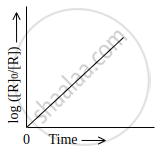
- What is the order of the reaction?
- What is the slope of the curve?
- Write the relationship between k and t1/2 (half life period).
The decomposition of formic acid on gold surface follows first-order kinetics. If the rate constant at 300 K is 1.0 × 10⁻³ s−1 and the activation energy Ea = 11.488 kJ mol−1, the rate constant at 200 K is ______ × 10−5 s−1. (Round off to the Nearest Integer)
(Given R = 8.314 J mol−1 K−1)
The slope in the plot of `log ["R"]_0/(["R"])` Vs. time for a first-order reaction is ______.
How will you represent first order reactions graphically?
The following data were obtained during the decomposition of SO2Cl2 at the constant volume. SO2Cl2 →SO2(g) + Cl2(g)
| Time (s) | Total Pressure (bar) |
| 0 | 0.5 |
| 100 | 0.6 |
Calculate the rate constant of the reaction.
