Advertisements
Advertisements
Question
Show that the time required for 99.9% completion of a first-order reaction is three times the time required for 90% completion.
Advertisements
Solution
For a first-order reaction,
`"t" = 2.303/"k" "log"_10 ["A"]_0/["A"]_"t"`
i. Time is taken for 99.9% completion:
Let the time taken for 99.9% completion of the reaction be t99.9%.
Let initial concentration, [A]0 = a
The final concentration, [A]t = a - 99.9% of a
= `"a" - (99.9/100 xx "a") = 0.001 "a"`
t99.9% = `2.303/"k" "log"_10 ["A"]_0/["A"]_"t"`
= `2.303/"k" "log"_10 "a"/(0.001 "a")`
= `2.303/"k" "log"_10 1000` ...(1)
ii. Time is taken for 90% completion:
Let the time taken for 90% completion of the reaction be t90%.
Let initial concentration, [A]0 = a
Then, final concentration, [A]t = a - 90% of a
= a - `(90/100 xx "a") = 0.1 "a"`
t90% = `2.303/"k" "log"_10 ["A"]_0/["A"]_"t" = 2.303/"k" "log"_10 "a"/(0.1 "a")`
= `2.303/"k" "log"_10 10` ...(2)
Dividing (1) by (2), we get
`("t"_99.9%)/("t"_90%) = (2.303/"k" "log"_10 1000)/(2.303/"k" "log"_10 10) = ("log"_10 1000)/("log"_10 10) = 3/1`
∴ `("t"_99.9%)/("t"_90%) = 3`
∴ t99.9% = 3 t90%
Therefore, for a first-order reaction, the time required for 99.9% completion is 3 times that required for 90% completion.
RELATED QUESTIONS
Sucrose decomposes in acid solution into glucose and fructose according to the first order rate law with t1/2 = 3 hours. What fraction of the sample of sucrose remains after 8 hours?
In a pseudo first order reaction in water, the following results were obtained:
| t/s | 0 | 30 | 60 | 90 |
| [A]/mol L−1 | 0.55 | 0.31 | 0.17 | 0.085 |
Calculate the average rate of reaction between the time interval 30 to 60 seconds.
The rate constant for a first order reaction is 60 s−1. How much time will it take to reduce the initial concentration of the reactant to its `1/16`th value?
For the decomposition of azoisopropane to hexane and nitrogen at 543 K, the following data are obtained.
| t (sec) | P(mm of Hg) |
| 0 | 35.0 |
| 360 | 54.0 |
| 720 | 63.0 |
Calculate the rate constant.
Following data are obtained for reaction :
N2O5 → 2NO2 + 1/2O2
| t/s | 0 | 300 | 600 |
| [N2O5]/mol L–1 | 1.6 × 10⁻² | 0.8 × 10⁻² | 0.4 × 10⁻² |
1) Show that it follows first order reaction.
2) Calculate the half-life.
(Given log 2 = 0.3010, log 4 = 0.6021)
A first order reaction takes 20 minutes for 25% decomposition. Calculate the time when 75% of the reaction will be completed.
(Given : log = 2 = 0·3010, log 3 = 0·4771, log 4 = 0·6021)
Define order of reaction. How does order of a reaction differ from molecularity for a complex reaction?
A first order reaction is 50% completed in 1.26 × 10¹⁴ s. How much time would it take for 100% completion?
Which of the following graphs is correct for a first order reaction?


State a condition under which a bimolecular reaction is kinetically first order reaction.
First order reaction is 50% complete in 1.26 × 10¹⁴s. How much time could it take for 100% completion?
A first order reaction is 50% complete in 20 minute What is rate constant?
In the first order reaction, half of the reaction is complete in 100 seconds. The time for 99% of the reaction to occurs will be
Observe the graph shown in figure and answer the following questions:
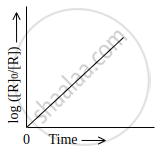
- What is the order of the reaction?
- What is the slope of the curve?
- Write the relationship between k and t1/2 (half life period).
Gaseous cyclobutene isomerizes to butadiene in a first order process which has a 'k' value of 3.3 × 10⁻⁴ s−1 at 153°C. The time in minutes it takes for the isomerization to proceed 40% to completion at this temperature is ______. (Rounded-off to the nearest integer)
The decomposition of formic acid on gold surface follows first-order kinetics. If the rate constant at 300 K is 1.0 × 10⁻³ s−1 and the activation energy Ea = 11.488 kJ mol−1, the rate constant at 200 K is ______ × 10−5 s−1. (Round off to the Nearest Integer)
(Given R = 8.314 J mol−1 K−1)
The reaction \[\ce{SO2Cl2(g) -> SO2(g) + Cl2(g)}\] is a first-order gas reaction with k = 2.2 × 10⁻⁵ sec−1 at 320°C. The percentage of SO2Cl2 is decomposed on heating this gas for 90 min, is ______%.
For a first order reaction, the ratio of the time for 75% completion of a reaction to the time for 50% completion is ______. (Integer answer)
The slope in the plot of `log ["R"]_0/(["R"])` Vs. time for a first-order reaction is ______.
Radioactive decay follows first-order kinetics. The initial amount of two radioactive elements X and Y is 1 gm each. What will be the ratio of X and Y after two days if their half-lives are 12 hours and 16 hours respectively?
The following data were obtained during the decomposition of SO2Cl2 at the constant volume. SO2Cl2 →SO2(g) + Cl2(g)
| Time (s) | Total Pressure (bar) |
| 0 | 0.5 |
| 100 | 0.6 |
Calculate the rate constant of the reaction.
Slove: \[\ce{2NOBr -> 2NO_{2(g)} + Br_{2(g)}}\]
For the above reaction, the rate law is rate = k[NOBr]2. If the rate of reaction is 6.5 × 10⁻⁶ mol L−1 s−1 at 2 × 10⁻³ mol L−1 concentration of NOBr, calculate the rate constant k for the reaction.
The rate constant for the reaction:
\[\ce{2N2O_{(s)} ->2N2O4_{(g)}}\] is 4.98 × 10⁻⁴ s-1.
The order of the reaction is ______.
Write the equation for integrated rate law for a first order reaction.
Show that `t_(1/2)= 0.693/k` for first reaction.
If the half-life (t1/2) for a first order reaction is 1 minute, then the time required for 99.9% completion of the reaction is closest to ______.
