Advertisements
Advertisements
Question
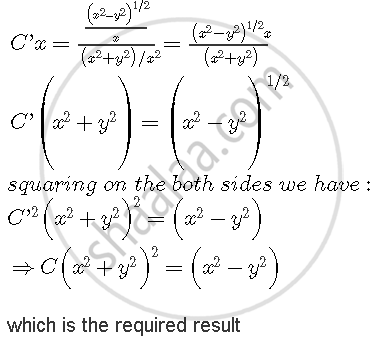
Prove that x2 – y2 = c(x2 + y2)2 is the general solution of the differential equation (x3 – 3xy2)dx = (y3 – 3x2y)dy, where C is parameter
Advertisements
Solution
The given equation is:
(x3 – 3xy2)dx = (y3 – 3x2y)dy
`=> (dy)/(dx) = (x^3 - 3xy^2)/(y^3 - 3x^2y)`
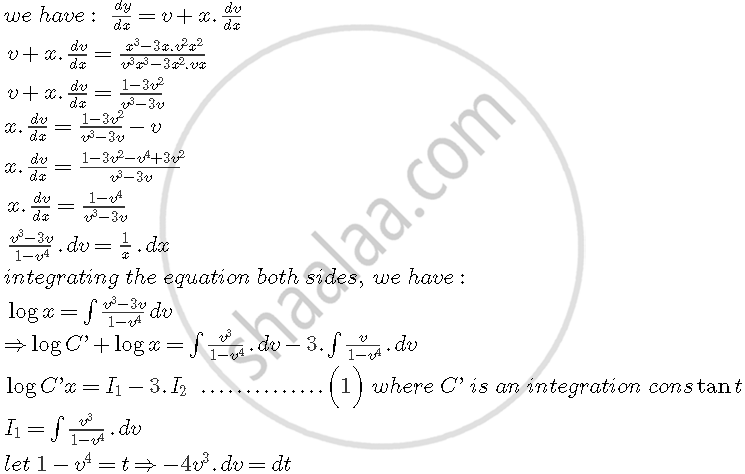
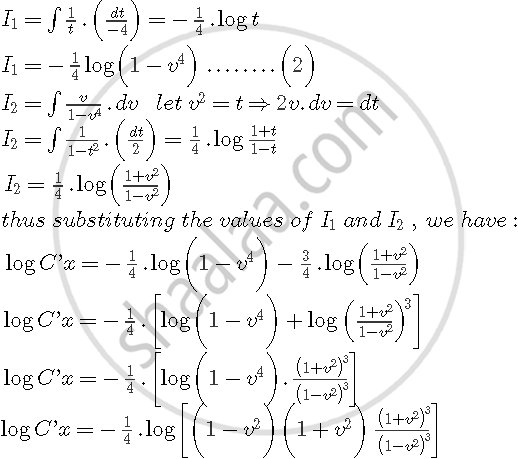
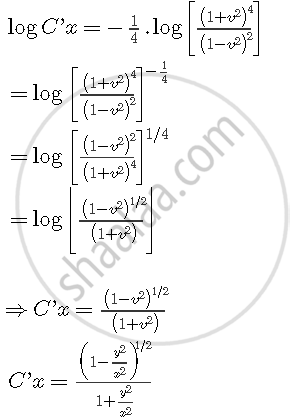
which is a homogeneous equation.therefore substituting y=vx
RELATED QUESTIONS
Solve the differential equation :
`y+x dy/dx=x−y dy/dx`
Show that the differential equation `2xydy/dx=x^2+3y^2` is homogeneous and solve it.
Show that the given differential equation is homogeneous and solve them.
`x dy/dx - y + x sin (y/x) = 0`
For the differential equation find a particular solution satisfying the given condition:
x2 dy + (xy + y2) dx = 0; y = 1 when x = 1
For the differential equation find a particular solution satisfying the given condition:
`[xsin^2(y/x - y)] dx + x dy = 0; y = pi/4 "when" x = 1`
For the differential equation find a particular solution satisfying the given condition:
`dy/dx - y/x + cosec (y/x) = 0; y = 0` when x = 1
For the differential equation find a particular solution satisfying the given condition:
`2xy + y^2 - 2x^2 dy/dx = 0; y = 2` when x = 1
Find the particular solution of the differential equation `(x - y) dy/dx = (x + 2y)` given that y = 0 when x = 1.
(x2 − 2xy) dy + (x2 − 3xy + 2y2) dx = 0
(x2 + 3xy + y2) dx − x2 dy = 0
Solve the following initial value problem:
\[x\frac{dy}{dx} - y + x \sin\left( \frac{y}{x} \right) = 0, y\left( 2 \right) = x\]
Solve the differential equation: ` (dy)/(dx) = (x + y )/ (x - y )`
Solve the following differential equation:
(x2 – y2)dx + 2xy dy = 0
State whether the following statement is True or False:
A homogeneous differential equation is solved by substituting y = vx and integrating it
State the type of the differential equation for the equation. xdy – ydx = `sqrt(x^2 + y^2) "d"x` and solve it
Which of the following is not a homogeneous function of x and y.
F(x, y) = `(x^2 + y^2)/(x - y)` is a homogeneous function of degree 1.
Solve : `x^2 "dy"/"dx"` = x2 + xy + y2.
The solution of the differential equation `(1 + e^(x/y)) dx + e^(x/y) (1 + x/y) dy` = 0 is
A homogeneous differential equation of the `(dx)/(dy) = h(x/y)` can be solved by making the substitution.
Let the solution curve of the differential equation `x (dy)/(dx) - y = sqrt(y^2 + 16x^2)`, y(1) = 3 be y = y(x). Then y(2) is equal to ______.
If a curve y = f(x), passing through the point (1, 2), is the solution of the differential equation, 2x2dy = (2xy + y2)dx, then `f(1/2)` is equal to ______.
