Advertisements
Advertisements
प्रश्न
Prove that x2 – y2 = c(x2 + y2)2 is the general solution of the differential equation (x3 – 3xy2)dx = (y3 – 3x2y)dy, where C is parameter
Advertisements
उत्तर
The given equation is:
(x3 – 3xy2)dx = (y3 – 3x2y)dy
`=> (dy)/(dx) = (x^3 - 3xy^2)/(y^3 - 3x^2y)`
which is a homogeneous equation.therefore substituting y=vx
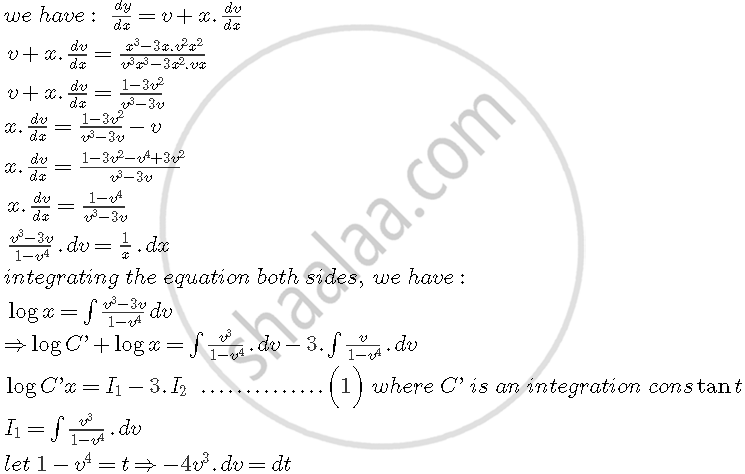
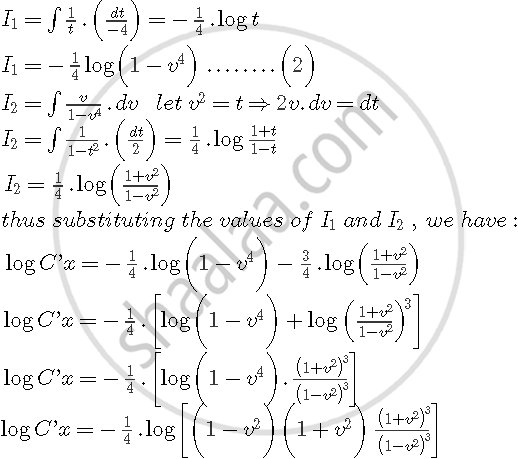
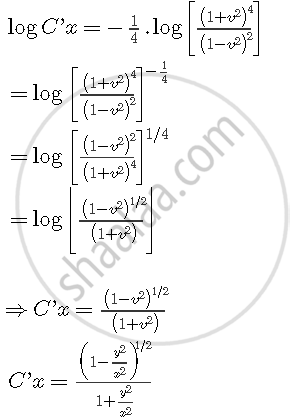
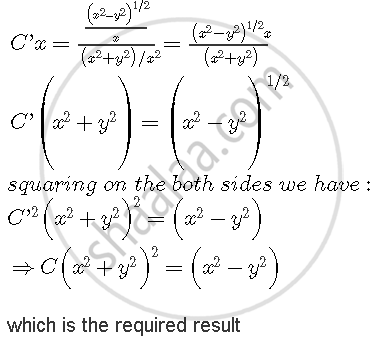
संबंधित प्रश्न
Solve the differential equation (x2 + y2)dx- 2xydy = 0
Show that the given differential equation is homogeneous and solve them.
`x dy/dx - y + x sin (y/x) = 0`
Show that the given differential equation is homogeneous and solve them.
`y dx + x log(y/x)dy - 2x dy = 0`
Show that the given differential equation is homogeneous and solve them.
`(1+e^(x/y))dx + e^(x/y) (1 - x/y)dy = 0`
For the differential equation find a particular solution satisfying the given condition:
x2 dy + (xy + y2) dx = 0; y = 1 when x = 1
For the differential equation find a particular solution satisfying the given condition:
`[xsin^2(y/x - y)] dx + x dy = 0; y = pi/4 "when" x = 1`
Which of the following is a homogeneous differential equation?
Solve the following initial value problem:
(y4 − 2x3 y) dx + (x4 − 2xy3) dy = 0, y (1) = 1
Solve the following initial value problem:
x (x2 + 3y2) dx + y (y2 + 3x2) dy = 0, y (1) = 1
Solve the following differential equation:
`(1 + 2"e"^("x"/"y")) + 2"e"^("x"/"y")(1 - "x"/"y") "dy"/"dx" = 0`
Solve the following differential equation:
`x * dy/dx - y + x * sin(y/x) = 0`
Solve the following differential equation:
`(1 + "e"^("x"/"y"))"dx" + "e"^("x"/"y")(1 - "x"/"y")"dy" = 0`
Solve the following differential equation:
x dx + 2y dx = 0, when x = 2, y = 1
Solve the following differential equation:
`x^2. dy/dx = x^2 + xy + y^2`
Solve the following differential equation:
(9x + 5y) dy + (15x + 11y)dx = 0
Which of the following is not a homogeneous function of x and y.
F(x, y) = `(ycos(y/x) + x)/(xcos(y/x))` is not a homogeneous function.
If a curve y = f(x), passing through the point (1, 2), is the solution of the differential equation, 2x2dy = (2xy + y2)dx, then `f(1/2)` is equal to ______.
The solution of the differential equation y2 dx + (x2 − xy + y2)dy = 0 is ______.
If \[F(\lambda x,\lambda y)=F(x,y)\] for any non-zero constant \[\lambda\], what is the degree of \[F(x,y)\]?
For the substitution \[y=vx\], which differentiated form is correct?
What form should the equation be reduced to before integration?
Writing \[x\cos\left(\frac{y}{x}\right)\frac{dy}{dx}=y\cos\left(\frac{y}{x}\right)+x\] in standard form gives which expression?
