Advertisements
Advertisements
Question
Prove that `(cos^2theta)/(sintheta) + sintheta` = cosec θ
Advertisements
Solution
L.H.S = `(cos^2theta)/(sintheta) + sintheta`
= `(cos^2theta + sin^2theta)/sintheta`
= `1/sintheta` .......[∵ sin2θ + cos2θ = 1]
= cosec θ
= R.H.S
∴ `(cos^2theta)/(sintheta) + sintheta` = cosec θ
APPEARS IN
RELATED QUESTIONS
Prove that ` \frac{\sin \theta -\cos \theta +1}{\sin\theta +\cos \theta -1}=\frac{1}{\sec \theta -\tan \theta }` using the identity sec2 θ = 1 + tan2 θ.
Prove the following trigonometric identities.
`(cot A + tan B)/(cot B + tan A) = cot A tan B`
`(sin theta+1-cos theta)/(cos theta-1+sin theta) = (1+ sin theta)/(cos theta)`
If x=a `cos^3 theta and y = b sin ^3 theta ," prove that " (x/a)^(2/3) + ( y/b)^(2/3) = 1.`
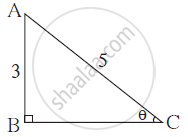
From the figure find the value of sinθ.
If cosec θ − cot θ = α, write the value of cosec θ + cot α.
Write the value of sin A cos (90° − A) + cos A sin (90° − A).
What is the value of \[\frac{\tan^2 \theta - \sec^2 \theta}{\cot^2 \theta - {cosec}^2 \theta}\]
If cosec θ = 2x and \[5\left( x^2 - \frac{1}{x^2} \right)\] \[2\left( x^2 - \frac{1}{x^2} \right)\]
Prove the following identity :
`(cotA - cosecA)^2 = (1 - cosA)/(1 + cosA)`
Prove that `(tan^2"A")/(tan^2 "A"-1) + (cosec^2"A")/(sec^2"A"-cosec^2"A") = (1)/(1-2 co^2 "A")`
Prove that:
`sqrt(( secθ - 1)/(secθ + 1)) + sqrt((secθ + 1)/(secθ - 1)) = 2 "cosec"θ`
Prove that: 2(sin6 θ + cos6 θ) – 3 (sin4 θ + cos4 θ) + 1 = 0.
Prove that sin (90° - θ) cos (90° - θ) = tan θ. cos2θ.
Without using trigonometric table, prove that
`cos^2 26° + cos 64° sin 26° + (tan 36°)/(cot 54°) = 2`
Prove the following identities.
`costheta/(1 + sintheta)` = sec θ – tan θ
If x = a tan θ and y = b sec θ then
The value of 2sinθ can be `a + 1/a`, where a is a positive number, and a ≠ 1.
If cot θ = `40/9`, find the values of cosec θ and sinθ,
We have, 1 + cot2θ = cosec2θ
1 + `square` = cosec2θ
1 + `square` = cosec2θ
`(square + square)/square` = cosec2θ
`square/square` = cosec2θ ......[Taking root on the both side]
cosec θ = `41/9`
and sin θ = `1/("cosec" θ)`
sin θ = `1/square`
∴ sin θ = `9/41`
The value is cosec θ = `41/9`, and sin θ = `9/41`
Prove the following trigonometry identity:
(sin θ + cos θ)(cosec θ – sec θ) = cosec θ ⋅ sec θ – 2 tan θ
