Advertisements
Advertisements
Question
Prove the following identity :
`(secA - 1)/(secA + 1) = sin^2A/(1 + cosA)^2`
Advertisements
Solution
LHS = `(secA - 1)/(secA + 1)`
= `(1/cosA - 1)/(1/cosA + 1) = (1 - cosA)/(1 + cosA)`
= `(1 - cosA)/(1 + cosA) xx (1 + cosA)/(1 + cosA)`
= `(1-cos^2A)/(1 + cosA)^2`
= `sin^2A/(1 + cosA)^2` (∵ `1 - cos^2A = sin^2A`)
APPEARS IN
RELATED QUESTIONS
Prove that sin6θ + cos6θ = 1 – 3 sin2θ. cos2θ.
Prove the following identities:
`(cotA + cosecA - 1)/(cotA - cosecA + 1) = (1 + cosA)/sinA`
If sec A + tan A = p, show that:
`sin A = (p^2 - 1)/(p^2 + 1)`
Prove that:
Sin4θ - cos4θ = 1 - 2cos2θ
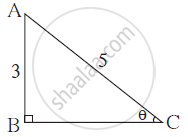
From the figure find the value of sinθ.
Prove that sin( 90° - θ ) sin θ cot θ = cos2θ.
Prove that `sqrt((1 + cos A)/(1 - cos A)) = (tan A + sin A)/(tan A. sin A)`
cos 45° = ?
If `1 - cos^2θ = 1/4`, then θ = ?
Prove that `(cot A)/(1 - tan A) + (tan A)/(1 - cot A) = 1 + tan A + cot A = sec A . "cosec" A + 1`.
