Advertisements
Advertisements
Question
If cosθ = `5/13`, then find sinθ.
Advertisements
Solution
cosθ = `5/13`
`sin^2θ + cos^2θ = 1`
`sin^2θ + (5/13)^2 = 1`
`sin^2θ = (1 - 25)/169`
`sin^2θ = (169 - 25)/169`
`sin^2θ = 144/169`
sinθ = `sqrt(144/169)`
sinθ = `12/13`
APPEARS IN
RELATED QUESTIONS
Prove the following identities:
`(1 - sinA)/(1 + sinA) = (secA - tanA)^2`
Prove the following identities:
(1 + cot A – cosec A)(1 + tan A + sec A) = 2
Prove the following identities:
`sqrt((1 + sinA)/(1 - sinA)) = cosA/(1 - sinA)`
If 2 sin A – 1 = 0, show that: sin 3A = 3 sin A – 4 sin3 A
Prove that:
`sqrt(sec^2A + cosec^2A) = tanA + cotA`
Prove the following identities:
`(sin theta + 1 - cos theta)/(cos theta - 1 + sin theta) = (1 + sin theta)/(cos theta)`
If `m = (cos θ - sin θ)` and `n = (cos θ + sin θ)`, show that `sqrt(m/n) + sqrt(n/m) = 2/sqrt(1 - tan^2θ)`.
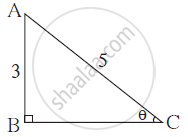
From the figure find the value of sinθ.
If cosec θ − cot θ = α, write the value of cosec θ + cot θ.
\[\frac{1 - \sin \theta}{\cos \theta}\] is equal to
Simplify
sin A `[[sinA -cosA],["cos A" " sinA"]] + cos A[[ cos A" sin A " ],[-sin A" cos A"]]`
Prove the following identity :
`(cotA + cosecA - 1)/(cotA - cosecA + 1) = (cosA + 1)/sinA`
Prove that:
`(cot A - 1)/(2 - sec^2 A) = cot A/(1 + tan A)`
There are two poles, one each on either bank of a river just opposite to each other. One pole is 60 m high. From the top of this pole, the angle of depression of the top and foot of the other pole are 30° and 60° respectively. Find the width of the river and height of the other pole.
Prove that `(sec θ - 1)/(sec θ + 1) = ((sin θ)/(1 + cos θ ))^2`
Prove that `sqrt((1 + cos A)/(1 - cos A)) = (tan A + sin A)/(tan A. sin A)`
Prove that `cos θ/sin(90° - θ) + sin θ/cos (90° - θ) = 2`.
Without using the trigonometric table, prove that
tan 10° tan 15° tan 75° tan 80° = 1
Prove that: `1/(sec θ - tan θ) = sec θ + tan θ`.
Which of the following is true for all values of θ (0° ≤ θ ≤ 90°)?
