Advertisements
Advertisements
Question
Out of (CH3)3 C-Br and (CH3)3 C-I, which one is more reactive towards SN1 and why?
Advertisements
Solution
In SN1 reactions, reactivity depends on the stability of carbocation after removing the leaving group form the reactant. Since the carbocation is the same here, so, we will see the tendency of leaving the group. As we can see in the following reactions Br and r are the leaving groups, out of them r is a better leaving group. Hence SN1 reaction will be faster in (CH3)3 C-I (CH3)3 - Br
\[\begin{array}{cc}
\ce{CH3}\phantom{..............}\ce{CH3}\\
\phantom{.}|\phantom{.................}|\phantom{...}\\
\ce{CH3-C-Br->CH3-C^+ + Br^-}\\
\phantom{.}|\phantom{.................}|\phantom{...}\\\ce{CH3}\phantom{..............}\ce{CH3}\\
\end{array}\]
\[\begin{array}{cc}
\phantom{...}\ce{CH3}\phantom{............}\ce{CH3}\\
\phantom{...}|\phantom{...............}|\phantom{...}\\
\ce{CH3-C-I->CH3-C^+ + I^-}\\
\phantom{...}|\phantom{...............}|\phantom{...}\\
\phantom{...}\ce{CH3}\phantom{............}\ce{CH3}\\
\end{array}\]
RELATED QUESTIONS
What happens when \[\ce{CH3 - Br}\] is treated with KCN?
Chlorobenzene is extremely less reactive towards a nucleophilic substitution reaction. Give two reasons for the same.
Write the final product(s) in each of the following reactions:

How the following conversion can be carried out?
Chlorobenzene to p-nitrophenol
Arrange the following compounds in increasing order of rate of reaction towards nucleophilic substitution.
| (a) |  |
| (b) |  |
| (c) |  |
Haloarenes are less reactive than haloalkanes and haloalkenes. Explain.
Allyl chloride is hydrolysed more readily than n-propyl chloride. Why?
Assertion: Chlorobenzene is resistant to nucleophilic substitution reaction at room temperature.
Reason (R): C–Cl bond gets weaker due, to resonance.
Why haloarenes are not reactive towards nucleophilic substitution reaction? Give two reactions.
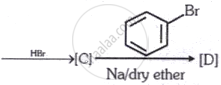
Identify the final product [D] obtained in the following sequence of reactions.
\[\ce{CH3CHO \underset{ii) H2O+}{\overset{i) LiAlH4}{->}} [A] \underset{\triangle}{\overset{H2SO4}{->}} [B]}\]