Advertisements
Advertisements
प्रश्न
Out of (CH3)3 C-Br and (CH3)3 C-I, which one is more reactive towards SN1 and why?
Advertisements
उत्तर
In SN1 reactions, reactivity depends on the stability of carbocation after removing the leaving group form the reactant. Since the carbocation is the same here, so, we will see the tendency of leaving the group. As we can see in the following reactions Br and r are the leaving groups, out of them r is a better leaving group. Hence SN1 reaction will be faster in (CH3)3 C-I (CH3)3 - Br
\[\begin{array}{cc}
\ce{CH3}\phantom{..............}\ce{CH3}\\
\phantom{.}|\phantom{.................}|\phantom{...}\\
\ce{CH3-C-Br->CH3-C^+ + Br^-}\\
\phantom{.}|\phantom{.................}|\phantom{...}\\\ce{CH3}\phantom{..............}\ce{CH3}\\
\end{array}\]
\[\begin{array}{cc}
\phantom{...}\ce{CH3}\phantom{............}\ce{CH3}\\
\phantom{...}|\phantom{...............}|\phantom{...}\\
\ce{CH3-C-I->CH3-C^+ + I^-}\\
\phantom{...}|\phantom{...............}|\phantom{...}\\
\phantom{...}\ce{CH3}\phantom{............}\ce{CH3}\\
\end{array}\]
संबंधित प्रश्न
What happens when \[\ce{CH3 - Br}\] is treated with KCN?
The presence of nitro group (−NO2) at o/p positions increases the reactivity of haloarenes towards nucleophilic substitution reactions.
How the following conversion can be carried out?
Chlorobenzene to p-nitrophenol
Assertion: Presence of a nitro group at ortho or para position increases the reactivity of haloarenes towards nucleophilic substitution.
Reason: Nitro group, being an electron-withdrawing group decreases the electron density over the benzene ring.
Arrange the following compounds in increasing order of rate of reaction towards nucleophilic substitution.
| (a) |  |
| (b) | 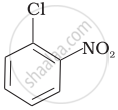 |
| (c) |  |
Arrange the following compounds in increasing order of rate of reaction towards nucleophilic substitution.
| (a) |  |
| (b) |  |
| (c) |  |
Arrange the following compounds in increasing order of rate of reaction towards nucleophilic substitution.
| (a) | 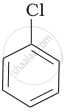 |
| (b) | 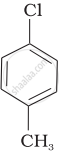 |
| (c) |  |
Allyl chloride is hydrolysed more readily than n-propyl chloride. Why?
\[\ce{C6H12O6 ->[(Zymase)] A ->[NaOH][\Delta] B + CHI3}\]
The number of carbon atoms present in the product B is:
In the reaction, \[\mathrm{CH}_3\mathrm{C}\equiv\mathrm{\overline{C}Na}^++(\mathrm{CH}_3)_2\mathrm{CHCl}\to\] the product formed is ______.
