Advertisements
Advertisements
प्रश्न
Assertion: Chlorobenzene is resistant to nucleophilic substitution reaction at room temperature.
Reason (R): C–Cl bond gets weaker due, to resonance.
विकल्प
Both (A) and (R) are true and (R) is the correct explanation of (A).
Both (A) and (R) are true, but (R) is not the correct explanation of (A).
(A) is true, but (R) is false.
(A) is false, but (R) is true.
Advertisements
उत्तर
(A) is true, but (R) is false.
Explanation:
Because of resonance, chlorobenzene acquires a partial double bond, making it extremely reactive to electrophilic substitution reactions.
APPEARS IN
संबंधित प्रश्न
Chlorobenzene is extremely less reactive towards a nucleophilic substitution reaction. Give two reasons for the same.
How the following conversion can be carried out?
Chlorobenzene to p-nitrophenol
Give reasons:
The dipole moment of chlorobenzene is lower than that of cyclohexyl chloride.
What is Grignard reagent?
Write chemical equation in support of your answer.
Out of  Cl and
  CH2- Cl, which one is more reactive towards nucleophilic substitution reaction and why?
Arrange the following compounds in increasing order of rate of reaction towards nucleophilic substitution.
| (a) |  |
| (b) | 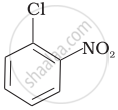 |
| (c) |  |
Arrange the following compounds in increasing order of rate of reaction towards nucleophilic substitution.
| (a) |  |
| (b) |  |
| (c) |  |
Arrange the following compounds in increasing order of rate of reaction towards nucleophilic substitution.
| (a) |  |
| (b) |  |
| (c) |  |
Haloarenes are less reactive than haloalkanes and haloalkenes. Explain.
\[\ce{C6H12O6 ->[(Zymase)] A ->[NaOH][\Delta] B + CHI3}\]
The number of carbon atoms present in the product B is:
