Advertisements
Advertisements
प्रश्न
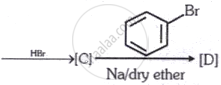
Write the final product(s) in each of the following reactions:

Advertisements
उत्तर

APPEARS IN
संबंधित प्रश्न
What happens when \[\ce{CH3 - Br}\] is treated with KCN?
Chlorobenzene is extremely less reactive towards a nucleophilic substitution reaction. Give two reasons for the same.
Give reasons:
The dipole moment of chlorobenzene is lower than that of cyclohexyl chloride.
Write chemical equation in support of your answer.
Out of  Cl and
  CH2- Cl, which one is more reactive towards nucleophilic substitution reaction and why?
Assertion: Presence of a nitro group at ortho or para position increases the reactivity of haloarenes towards nucleophilic substitution.
Reason: Nitro group, being an electron-withdrawing group decreases the electron density over the benzene ring.
Arrange the following compounds in increasing order of rate of reaction towards nucleophilic substitution.
| (a) |  |
| (b) |  |
| (c) |  |
Haloarenes are less reactive than haloalkanes and haloalkenes. Explain.
\[\ce{C6H12O6 ->[(Zymase)] A ->[NaOH][\Delta] B + CHI3}\]
The number of carbon atoms present in the product B is:
Why haloarenes are not reactive towards nucleophilic substitution reaction? Give two reactions.
Identify the final product [D] obtained in the following sequence of reactions.
\[\ce{CH3CHO \underset{ii) H2O+}{\overset{i) LiAlH4}{->}} [A] \underset{\triangle}{\overset{H2SO4}{->}} [B]}\]