Advertisements
Advertisements
Question
Observe the figure and write the answers to the following questions.
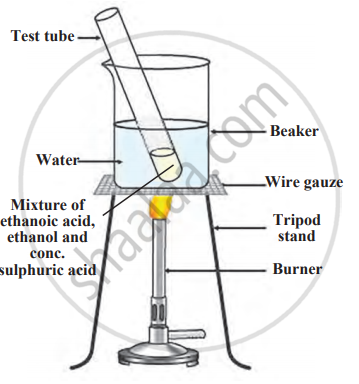
- Write the name of the reaction shown in the following figure.
- Write the above chemical reaction in the form of a balanced equation.
- Write the name of the product produced in the above reaction, write a use.
- Write the name of the catalyst used in the above reaction.
Advertisements
Solution
- The reaction shown in the figure is esterification.
- Balanced equation of the reaction between ethanol and ethanoic acid is as follows:
\[\ce{\underset{\text{Ethanol}}{C2H5OH} + \underset{\text{Ethanoic acid}}{CH3COOH} ->[Conc.][H2SO4] \underset{\text{Ethyl ethanoate}}{CH3COOC2H5} + \underset{\text{Water}}{H2O}}\] - The product formed is ethyl ethanoate.
Use: It is used for making fragrances and flavouring agents. - The catalyst used in the reaction is concentrated sulphuric acid.
APPEARS IN
RELATED QUESTIONS
Write three different chemical reactions showing the conversion of ethanoic acid to sodium ethanoate. Write balanced chemical equation in each case. Write the name of the reactants and the products other ethanoic acid and sodium ethanoate in each case.
A student adds a spoon full of powdered sodium hydrogen carbonate to a flask containing ethanoic acid. List two main observations, he must note in his note book, about the reaction that takes place. Also write chemical equation foe the reaction.
List two uses of esters.
Complete the following chemical equations:
C2H5OH+CH3COOH`("conc."H_2SO_4)/`>
Identify the term or substance based on the descriptions given below
Ice like crystals formed on cooling an organic acid sufficiently.
Fill in the blanks from the choices given within brackets:
The basicity of acetic acid is-------- (3, 1, 4).
Write the name and chemical formula of the simplest organic acid.
The next higher homologue of ethanol is ______.
The organic acid present in vinegar is ______.
What will you observe when dilute ethanoic acid and dilute hydrochloric acid are put on universal indicator paper, one by one? What does it show?
Write the names of the first three members of the carboxylic acid series.
What do you notice when acetic acid reacts with litmus?
In an experiment to study the properties of acetic acid a student takes about 2 mL of acetic acid in a dry test tube. He adds about 2 mL of water to it and shakes the test tube well. He is likely to observe that:
(A) the acetic acid dissolves readily in water
(B) the solution becomes light orange
(C) water floats over the surface of acetic acid
(D) acetic acid floats over the surface of water
On adding acetic acid to sodium hydrogen carbonate in a test tube, a student observes
(A) no reaction
(B) a colourless gas with pungent smell
(C) bubbles of a colourless and odourless gas
(D) a strong smell of vinegar
Write the important uses of acetic acid.
Write a balanced equation for the following:
Write the equation for the preparation of ethylene from ethyl alcohol.
State how the following conversions can be carried out:
Ethene to Ethyl alcohol.
Write the molecular formula of the given compound.
Ethanoic acid
Write the chemical equation for the following:
Esterification Reaction
Raina while doing certain reactions observed that heating of substance ‘X’ with a vinegar-like smell with a substance ‘Y’ (which is used as an industrial solvent.) in the presence of conc. Sulphuric acid in a water bath gives a sweet-smelling liquid ‘Z’ having molecular formula C4H8O2. When heated with caustic soda (NaOH), ‘Z’ gives back the sodium salt and the compound ‘Y’.
Identify ‘X’, ‘Y’, and ‘Z’. Illustrate the changes with the help of suitable chemical equations.
