Advertisements
Advertisements
प्रश्न
Observe the figure and write the answers to the following questions.
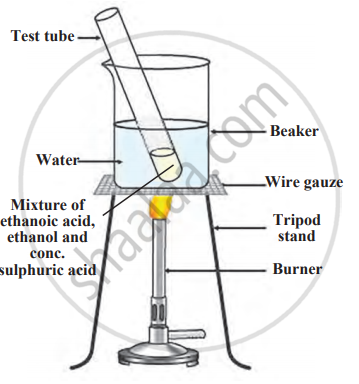
- Write the name of the reaction shown in the following figure.
- Write the above chemical reaction in the form of a balanced equation.
- Write the name of the product produced in the above reaction, write a use.
- Write the name of the catalyst used in the above reaction.
Advertisements
उत्तर
- The reaction shown in the figure is esterification.
- Balanced equation of the reaction between ethanol and ethanoic acid is as follows:
\[\ce{\underset{\text{Ethanol}}{C2H5OH} + \underset{\text{Ethanoic acid}}{CH3COOH} ->[Conc.][H2SO4] \underset{\text{Ethyl ethanoate}}{CH3COOC2H5} + \underset{\text{Water}}{H2O}}\] - The product formed is ethyl ethanoate.
Use: It is used for making fragrances and flavouring agents. - The catalyst used in the reaction is concentrated sulphuric acid.
APPEARS IN
संबंधित प्रश्न
What are esters ?
Give a reason:
Conductivity of dilute hydrochloric acid is greater than that of acetic acid
When zinc powder is added to acetic acid ______________
(a) the mixture becomes warm
(b) a gas is evolved
(c) the colour of the mixture becomes yellow
(d) a solid settles at the bottom
What is the common name of ethanoic acid?
Give the common name and IUPAC name of the following compound:
CH3COOН
Which of the following will give brisk effervescence with sodium hydrogen carbonate and why?
CH3COOH, CH3CH2OH
A neutral organic compound is warmed with some ethanoic acid and a little of conc. H2SO4. Vapours having sweet smell (fruity smell) are evolved. What type of functional group is present in this organic compound?
Consider the following organic compound:
CH3OH, C2H5OH, CH3COCH3, CH3COOH, C2H5COOH, C4H9COOC2H5, CH4, C2H6, CH3CHO, HCHO
Out of these compound:
Which compound is a constituent of vinegar?(e) Which compound is a constituent of vinegar?
An organic acid X is a liquid, which often freezes during winter time in cold countries, having the molecular formula C2H4O2. On warming it with methanol in the presence of a few drops of concentrated sulphuric acid, a compound Y with a sweet smell is formed.
(a) Identify X and Y. Also write their formulae showing the functional group present in them.
(b) Write a chemical equation for the reaction involved.
Write the names of three compounds which can be oxidised directly or in stages to produce acetic acid.
What is glacial acetic acid?
How is acetic acid prepared from acetylene?
What do you observe when acetic acid is added to sodium bicarbonate?
While studying saponification reactions, the following comments were noted down by the students :
(I) Soap is a salt of fatty acids.
(II) The reaction mixture is basic in nature.
(III) In this reaction heat is absorbed.
(IV) This reaction is not a neutralisation reaction.
Which of these are the correct comments ?
(A) I and III only
(B) I, II and III
(C) II, III and IV
(D) I and II only
Write a fully balanced equation for the folowing case:
Acitic acid is warmed with ethanol in the presence of concentrated sulpheric acid.
When acetaldehyde is oxidized with acidified potassium dichromate, it forms ______.
Write the characteristics of ethanoic acid.
Which of the following represents saponification reaction?
Give the balanced chemical equation of the following reaction:
Oxidation of ethanol by acidified potassium dichromate.
Give the balanced chemical equation of the reaction.
Oxidation of ethanol by acidified potassium dichromate.
