Advertisements
Advertisements
Question
What do you observe when acetic acid is added to sodium bicarbonate?
Advertisements
Solution
When acetic acid is added to sodium bicarbonate, it liberates brisk effervescence of carbon dioxide with carbonates or hydrogen carbonates.
\[\ce{CH3COOH + NaHCO3 -> CH3COONa + H2O + CO2↑}\]
APPEARS IN
RELATED QUESTIONS
A student puts a drop of reaction mixture of a saponification reaction first a blue litmus paper and then on a red litmus paper. He may observe that:
(a) There is no change in the blue litmus paper and the red litmus paper turns white.
(b) There is no change in the red litmus paper and the blue litmus paper turns red.
(c) There is no change in the blue litmus paper and the red litmus paper turns blue.
(d) No change in colour is observed in both the litmus papers
Complete the following chemical equation:
\[\ce{CH3COOC2H5 + NaOH ->}\]
Complete the following chemical equations : C2H5OH + Na →
Name two oxidising agents which can oxidise ethanol to ethanoic acid.
Describe one reaction of a carboxylic acid.
Name the functional group present in the following compound:
C2H5CHO
Write the important uses of acetic acid.
Using appropriate catalysts, ethane can be oxidized to an alcohol. Name the alcohol formed when ethane is oxidized.
Distinguish between esterification and saponification reactions with the help of chemical equations for each.
Observe the figure and write the answers to the following questions.
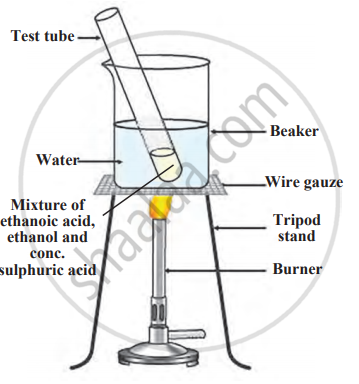
- Write the name of the reaction shown in the following figure.
- Write the above chemical reaction in the form of a balanced equation.
- Write the name of the product produced in the above reaction, write a use.
- Write the name of the catalyst used in the above reaction.
