Advertisements
Advertisements
Question
Now, write a set of 8 to 10 instruction for the following situation.
A traffic police personnel to the public, as to how to move around in safety, in crowded public places during festival seasons.
Advertisements
Solution
- Don’t allow your children to walk ahead of you.
- Make your children memorize your phone numbers or give them an id card with your phone numbers written on it.
- Ask your children not to speak or take anything from a stranger.
- Park your vehicles only in the open area marked as a parking area behind the police stations.
- Use the entry path to the fair.
- Go out only through the exit route demarcated by the long rope.
- In case of any problem or suspicion, contact the nearest police booth and inform the officer there.
- Makeshift toilets are kept separately for men and women at the right corner.
- Don’t run in a crowd.
- Walk with your family in a row’ of two members keeping track of children.
APPEARS IN
RELATED QUESTIONS
When are folk dances and folk music usually performed?
Pick out two words from the article on folk culture and folklore of Tamil Nadu with which you can form anagrams. Take turns and ask your partner to solve the anagram and come out with the right words.
Work in groups of four. Discuss how the story would have been different if.
Pongo had forgotten to lock the door properly but the narrator only discovered it just before Pongo returned.
Identify the character or speaker of the following line.
She stood petrified with astonishment peering over her glasses.
Read the story. Divide yourselves into groups of four. Discuss what little Sarah wants to talk about. Take roles and enact the story.
“Do you know why she is unhappy?”
He asked me if ______ unhappy.
“How many photos have you got?”
He wants to know how many ______.
Read the different verb form where they remain the same in the direct and indirect speech in the following case. Fill in the blank with missing indirect speech.
With would rather, had better,

Read the different verb form where they remain the same in the direct and indirect speech in the following case. Fill in the blank with missing indirect speech.
We do not usually change the modal verbs must and needn’t. But must can become had to or would have to and needn’t can become didn’t have to or wouldn’t have to if we want to express an obligation. Would/wouldn’t have to are used to talk about future obligations.
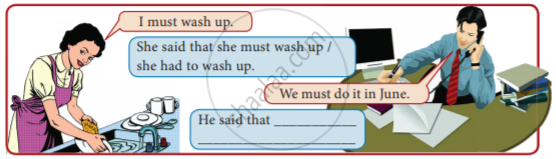
Do you work individually or in pairs?
Change the following into Indirect Speech.
“Bring me a glass of milk,” said the swami to the villagers.
Change the following into Indirect Speech.
“Take off your hat,” the king said to the Hatter.
Change the following into Direct Speech.
I told them to be quiet.
Name the speaker.
| S.No. | Lines from the lesson | Speaker |
| 1 | “Do you do anything other than eating?" | |
| 2 | “Are you feeling unwell?” | |
| 3 | “I don’t have a camera phone “ | |
| 4 | “I told you I am thirteen, the same age as you." | |
| 5 | “You are a brave pair!” |
Imagine that you and your friend have decided to spend a day together in your house. You have planned your schedule from morning till night. Discuss in pairs and speak about it in the class. You can start like this:
I like to go for a walk but my friend wants to work out in the gym.
Name the character or speaker.
“I am fine. We must wear the space suit.”
Find the qualities of these animals from the passage.
A little
red hen had some wheat seeds. “Will you help me sow this seed?” asked the hen,“No” replied the selfish dog. Then the hen did it by herself. The seeds grew into a field of wheat. “Will you help me reap the wheat?” asked the hen, “No” replied the sleepy cat. She did it by herself. “Will you help me grind the wheat?” asked the hen, “No” replied the noisy duck. She did it by herself. “Will you help me make a bread?” asked the hen, “No” replied the lazy cow. She made the bread by herself. “Will you all help me eat this bread?” asked the hen, “Yes” replied everyone,“No” said the hen.
 |
 |
 |
 |
Using the following clues write about yourself in the space below — name, place you live in, physical features, habits, likes and dislikes, etc.
Imagine you are Alice and your partner is a rabbit. What would you do?
What is the script for children who cannot see called?
Do you think that –
Hiawatha liked learning new languages?
What is your mother tongue?
Tick (✓) the words which end with the sound id. Say each word aloud
| accepted | |
| answered | |
| irritated | |
| failed | |
| completed | |
| challenged | |
| cried | |
| surprised | |
| find | |
| licked | |
| celebrated | |
| fried |
In a group, mime an activity (picnic, fair/mela, cricket match, etc.) which you enjoy. The rest of the class should guess the activity and say whether it is done in a group/alone.
Work in pairs and arrive at five points that bring out the benefits and challenges of living in either a nuclear family or a joint family. Share your views with your class.
Build a dialogue of 8–10 exchanges between your friend and yourself, on the following situation:
You were to board a train to Delhi. By mistake, you got into the wrong train and fought for your seat there. On realising your mistake, you left the train shamefaced, after creating a commotion there. Role-play this situation before the class.
Speak to the class for a minute, as to how one should conduct oneself on formal occasions. (You could talk about table manners especially while eating, general appearance, manner of speaking, etc.)
Speaking Activity
Based on your understanding of the play ‘The Never – Never Nest’, organise a classroom debate on the topic: ‘Is Equated Monthly Instalment Scheme - a boon or bane to middle-class families?’
Imagine you are Baldwin and your partner is Gresham. Try your best to persuade your partner to confess the truth. Build a conversation describing how both of you would react in such a situation. Work in pairs.
Conduct a debate for and against the motion.“Mobile phone - a big boon”
